
Let’s Go Nowhere…Real Fast!
The Story of Slats, the Silly Killers, and the 1980s Seattle Music Scene

Eric N. Danielson
(01-01-25)
Table of Contents
Preface
Introduction: Slats’ Early Life
I. The Zipdads
II. The Silly Killers
III. Itchy Brother
IV. Cheating Death
V. My Memories of Slats in the 1980s
VI. The 1990s: Slats’ Lost Decade
VII. Pain Cocktail: Slats’ Rebirth and Death
Post Script
Preface
This essay utilizes the life of Christopher Sedgwick Harvey (aka Slats) [March 14, 1963 - March 13, 2010] as a common thread to tie together disparate people, bands and venues of the 1980s Seattle music scene.
Introduction: Slats’ Early Life
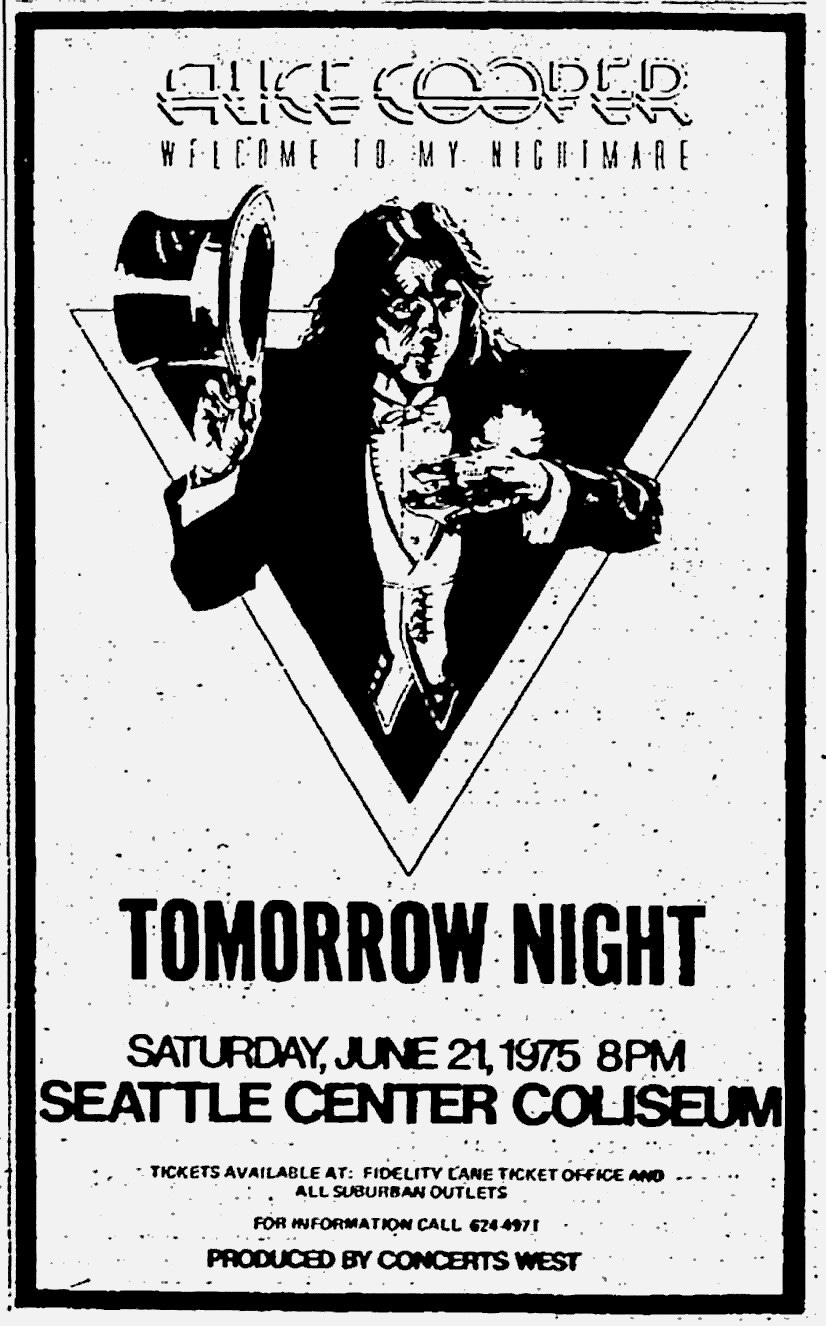
It all started with an Alice Cooper concert in 1975. Chris Harvey (aka Slats) had decided to attend his first ever rock concert, while still a pre-teen living alone with his divorced mother, Mary Ann Sedgwick (November 29, 1933 - December 14, 2013) in her house in Seattle’s upscale Montlake neighborhood. His loving mother insisted that he couldn’t go to the concert alone, and that he would have to find an adult chaperone, but with an absent father, no older brother, and apparently no friends, older or otherwise, Slats had nobody who would go with him. To solve the problem, Slats asked an old grandma in the neighborhood if she would go with him, and she said yes. So Slats and the grandma went together to see Alice Cooper live in concert. The show made such a deep impression on him that it set him on the path of rock n’ roll forever. As Slats’ told me, “He chopped his own head off and everything!” According to him, even the Grandma “loved it.” Based on Slats’ description and Alice Coopers concert history, this had to be the “Welcome to My Nightmare” tour, during which Cooper played the Seattle Center Coliseum on June 21, 1975. Prior to that it would have been the Alice Cooper Band, which had a different sound and stage show, plus Slats would have been too young to go, while after 1975 Cooper didn’t return to Seattle again until 1979, after he had sobered up.
In 1975-1976, Slats was in middle school with his 7th grade classmates Nick Scott, Alan Anderson, and Tom Price. Alan Anderson recalls that Alice Cooper was one of Slats’ favorite rock music artists at that time. In 8th grade, in 1977-1978, Sats, Alan Anderson and Tom Price all started taking guitar lessons from the same instructor, Steve Starwich, at a music store in the University Village shopping center. Starwich taught all three of them how to play the pentatonic blues scale, barre chords, and some music theory.
Slats and his middle school buddies Nick Scott, Alan Anderson and Tom Price drifted apart a bit when they all went off to different high schools. Slats went to Garfield High School, but Nick Scott and Tom Price went to Roosevelt High School and Alan Anderson went to the Bush School. However, they continued to meet up on the Ave (aka University Way) where they shopped at all the used record stores, such as Cellophane Square, Second Time Around, and Yesterday & Today.
Nick Scott started attending shows at the Seattle all ages live music club known as the Bird in 1978, and became an early fan of the Damned, the Dickies, and the Ramones, all of which undoubtedly had an influence on his friends Slats, Alan Anderson, and Tom Price. At the age of 15, Alan Anderson, Tom Price, and Nick Scott formed the band that later became known as PsychoPop, with Anderson on guitar, Price on bass, and Scott on drums. For a while, Slats was also jamming with them at rehearsals as the second guitar player, but for some reason it didn’t work out and he never actually played a live show with them.
As opposed to punk rock in the U.K. emerging out of poor working class neighborhoods in London like Brixton, in Seattle the first wave of punk rockers appeared around 1976-1979 in a band of upper middle class neighborhoods between the U-District and Lake Washington stretching from Laurelhurst to Montlake and Wedgewood, with many attending Roosevelt or Nathan Hale High School, and University Way NE, aka “The Ave,” becoming a central gathering place for them to hang out on the street. These were kids who weren’t poor, but often came from broken homes with divorced parents and were socially disaffected, maybe not unlike the situation in Orange County, CA around the same time.
Based on his last Washington state ID card issued in 2006, Slats was six feet tall, weighed 160 pounds, had blue eyes, and a very big nose. The fact that he had a state identification card, but not a driver’s license is indicative of the fact that he never owned a car and always relied on taking the bus, a taxi, or riding with someone else who did drive. Nick Scott does recall that Slats did once have a car as a very young man, which means that he must have once had a driver’s license, but by 1984 he seems to have lost his license and stopped driving for some reason.
His bandanas and hats usually covered it up, but he actually had naturally curly reddish hair. Through 1980-1982 and into the Spring of 1983 he had a very short haircut, punctuated by a pair of long sideburns on both sides of his face, but by the Summer of 1983 he had started to grow it out, and by the time of the Metropolis shows in the Fall of 1983 he had a head of bushy, curly, red hair. His hair style stayed that way for the rest of his life, except that from the Spring of 1983 it was usually covered up by various headgear, including a combination of bandanas and hats that were often worn simultaneously.
By the time he got into punk rock, Slats’ favorite bands had become the Ramones, the Dickies, D.O.A., and a bit later Social Distortion. One of his first and favorite punk rock records was a 10” vinyl E.P. released by the Dickies in 1978 featuring the songs “Paranoid” (a Black Sabbath cover), “Hideous,” and “You Drive Me Ape.” The record is notable for its unusual cover photo, which shows the band’s lead singer Leonard hanging upside down while wearing a straight jacket, with the other four band members looking onward. Both musically and visually I think this record provides some clues as to Slats’ punk rock origins.
Coincidentally, Seattle’s first all-ages punk rock live music club the Bird was also briefly opened at its original 107 Spring Street location downtown for about three months from March 4 to June 1, 1978 by members of the local punk rock band the Enemy and their manager Roger Husbands, followed by a series of fairly regular punk rock shows held by the Bird-in-Exile at the IOOF Oddfellows Hall in 1978-1979, and other rented halls around town, featuring local punk rock bands such as the Mentors, the Lewd, the Cheaters, and the Radios. It’s not known if Slats attended the Bird, but his childhood friends Nick Scott and Tom Price both did, and they undoubtedly influenced him.
Later on, I would say that musically and lyrically the Silly Killers carried on the tradition started by the Mentors and the Lewd (and Fear) of not being overtly left-wing political but making critical social commentary in their own way. Certainly, when I first met both of them in the early 1980s, Slats was already close friends with Brad Ramels of the Lewd.
Slats was mostly a fan of North American punk rock, but he did like the U.K. Subs. In the May 1983 Kid Dome photo he can be seen wearing a U.K. Subs T-shirt, as well as policeman’s hat that was his chosen headgear in 1983. He can be seen wearing this combination of the U.K. Subs T-shirt and a cop’s hat in several photos from that year.


Photo Credits Clockwise Zigzag: 1) Photo Booth, 2) Slats in front of Roxy Music record store on the ave in 1981 by Emily Rieman, 3) Slats’ with black eye, photographer unknown, 4) Slats with white Gibson SG at the Metropolis in 1983 by Carlene Heitman, 5) Slats on the Ave in his Silly Killers black leather jacket by unknown, 6) Photo Booth, 7) Photo Booth, 8) Slats on the Ave in his two-tone pants circa 1985, by Lance Mercer, 9) Dickies 1978 “Paranoid” single.
I. The Zipdads
Slats’ first band was the Zipdads, which existed briefly for about eight months from December 1980 to July 1981. Slats was the band’s sole guitar player, playing his Gibson SG guitar that became his trademark for the rest of the 1980s, while the other members included Scott Dittman on vocals, Duff McKagan on bass, and Andy Fortier on drums. This was the third band that Duff McKagan and Andy Fortier had played in together as a rhythm section, starting with the Vains, then Cleavage, and then the Zipdads. Although this was Slats’ first band, all three of the other members of the Zipdads had been in bands before that had even released records, albeit locally produced 7” vinyl singles. So, in a way, despite being a new band, the Zipdads already had an impressive pedigree, with roots that included the Cheaters, the Vains, and Cleavage.
The Cheaters
Scott Dittman had previously been the singer for the Cheaters, which was also the first band for both Kurt Bloch, who played guitar, and his brother Al Bloch, who was on bass. They were initially joined by Dave Shumate on drums, but after he quit James Gascoigne, later of the Queen Annes, briefly replaced him.
The Cheaters existed from Spring 1978 to Fall 1979. Their first show was on March 17th, 1978 at the brief-lived all ages club known as the Bird at 107 Spring Street, on only its third weekend, opening for Negative Trend. The Cheaters broke up because at their last show ever Scott Dittman and Al Bloch got into a fist fight on stage during a Halloween performance at the UCT Hall on Friday, October 26, 1979, after they had both shown up wearing the same costume dressed as a nurse. Dittman was always known as a no-nonsense tough guy who could be nice to his friends but could also easily kick somebody’s ass if anything irritated him.
The Cheaters put out one posthumous 7” vinyl single in 1980, after the band had already broken up, on Kurt Bloch’s own No Three’s record label, “Man As Hunter” b/w “I Talk To You” and “How Would You Like to Be The Iceman?” They also had a lot of other unreleased recordings of songs like “I Want To Be Electric,” and “Outta My Way,” which frankly I think sounded better do to their rawer, more punk rock sound, that didn’t finally come out until a posthumous twelve-song album that Kurt released decades later in 2015 as “See You Next Year, Fuckbrains!” There is also a live recording of a full Cheaters set recorded at Washington Hall in 1979 that still has never been released, but would be absolutely killer diller to hear.
Sadly, Scott Dittman passed away over 20 years ago on Saturday, November 8, 2003 at the young age of only 44 years old, but is survived by his wife Barbara Baird Dittman.
Al and Kurt Bloch reunited under the Cheaters name for one night only on March 3, 2018 at the Crocodile, as part of the Bird’s 40th anniversary, but without Dittman or Shumate.


Above is a photo gallery of archival photos of and posters for the Cheaters. Not all the Cheaters photo credits are known, but many were probably taken by Rob Brown.
The Vains
Duff McKagan and Andy Fortier had both previously been in the Vains in 1979-1980, along with Chris Utting, aka Criss Crass. In 1980 they released one 7” single on Kurt Bloch’s No Three’s record label, “School Jerks” b/w “The Fake” and “The Loser,” the later song being about Mike Refuzor (e.g. “Refuzor, you loser!”). On the single the members were credited by various fake names, drummer Andy Fortier was called “Andy Freeze,” a nickname he never used again after that; while bass player Duff McKagan was called “Nico Teen,” a nickname he also soon stopped using; and guitar player Chris Utting was called “Criss Crass,” a nickname by which most people still know him today. The Vains only played about 3-4 shows, the most famous being one on May 2, 1980 opening for Black Flag and the Canadian Subhumans at Washington Hall. This was the Ron Reyes fronted version of Black Flag, before either Dez Cadena or Henry Rollins had joined. The Subhumans reportedly never played because a riot broke out during Black Flag’s set after Ron Reyes was hit in the eye by a quarter thrown at him by someone in in the audience. The Vains broke up after playing only a few shows in 1980 mainly due to personal conflicts the other two members had with Criss Crass, who was a bit of a perfectionist task-master, while McKagan and Fortier went on as sort of team in several other bands, and have remained best friends for life until this very day. Nonetheless, there were several one-off Vains reunion shows in the early 1980s.
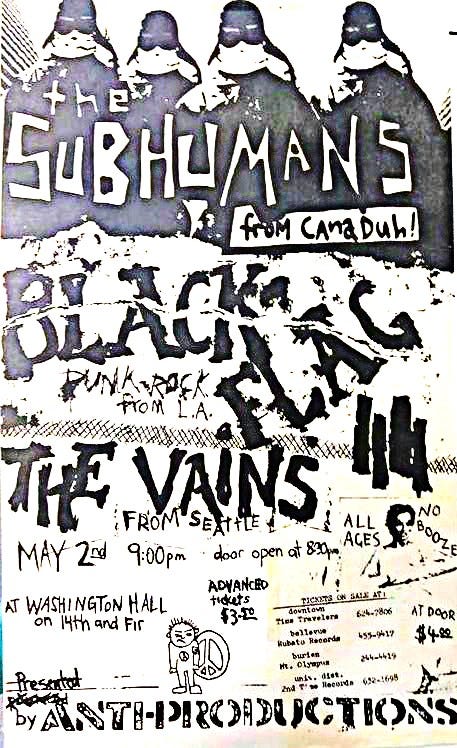
May 2, 1980 poster for the Vains, Black Flag, Subhumans show at Washington Hall.
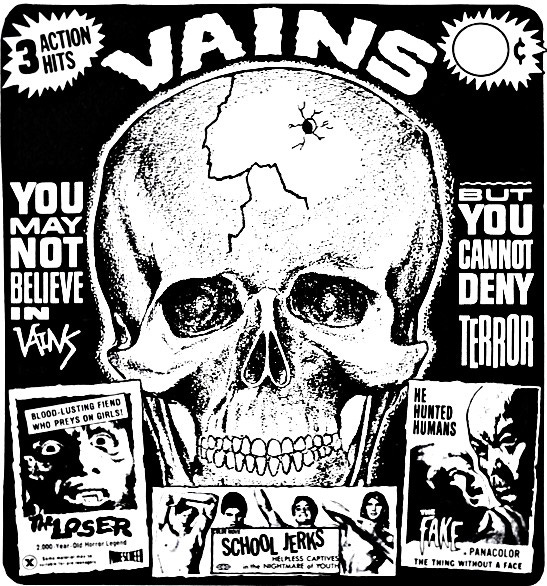
The Vains 1980 single front cover.
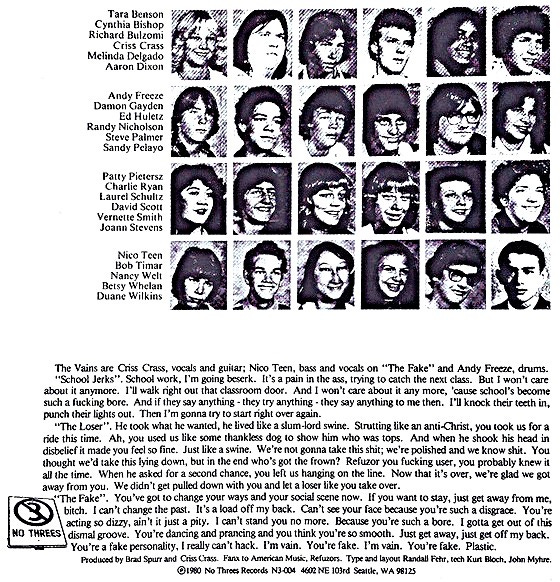
The Vains single 1980 back cover, with Roosevelt High School yearbook photos.
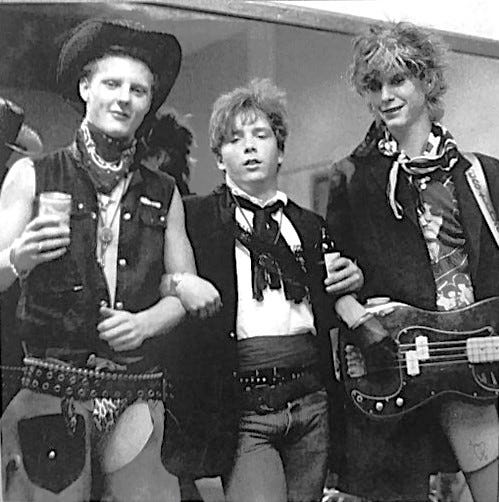
The only known photo of the Vains, taken at a reunion show circa 1983-1984 by Lance Mercer.
Cleavage
By June 1980, Duff and Andy had gone on briefly to a band called Cleavage that only existed briefly or three or four months in the Summer of 1980 and broke up by September 1980. Cleavage also included Johnny Vinyl and Jeff Larson, who later went on to found the Missing Link, and then AAIIEE! Prior to this, in 1979 Johnny Vinyl had previously been in a band called the Radios with Kim Warnick, Alan Michaels, and Criss Crass. Johnny Vinyl recalls first meeting Slats hanging around during the Cleavage period in the Summer of 1980.
Cleavage’s main claim to fame was having a band house in the U-District called “Cleaveland,” where in the Summer of 1980 Black Flag attempted to play an impromptu set at a house party that was shut down by the cops, and Criss Crass’ P.A. was ruined when Ron Reyes poured a can of beer all over its mixing board. Black Flag had already played a show at the Showbox on August 16, 1980 with Solger, which proved to be the latter’s last show.
The Formation of the Fartz
It was at this mid-August 1980 after-show party at the Cleaveland house that the Fartz first lineup formed, with Blaine Cook, Tom Hansen (1961 – 2023) Lloyd Shattuck aka Loud Fart, and Stephen D. Hofmann (1957-2017), who was married to Jane “Playtex” Brownson, , aka Jane Leslie Schmidt, the original bass player for “The Fags,” all four deciding that they should start a band, besides the fact that Blaine had never been the singer for a band before, Steve had never played bass before and had to be taught how by Tom Hansen, and Loud had never been a drummer before, although he had been a guitar player. Tom Hansen was the only one who was really a professional-level musician and took on the role of writing all the music, while Steve Hoffman wrote the left-wing political lyrics. Hansen and Loud had been playing guitar together in the band KAOS, while Cook and Hoffman had been working together at the original Red Robin restaurant.
Duff in the Fastbacks
For the purpose of our narrative here, the brief existence of the band Cleavage is most useful for dating the demise of the Vains before it started, and the rise of the Zipdads after it ended. As such, Cleavage is a sort of “missing link” in the narrative.
After Cleavage, Duff most famously joined the Fastbacks for less than a year in 1981 as their second drummer and played on their first 7” single, “It’s Your Birthday” b/w “You Can’t Be Happy,” recorded in January 1981.
However, during the same time that Duff McKagan was in the Fastbacks he was also in the Zipdads. The Fastbacks played their first live show with Duff on drums at the Gorilla Room on December 5, 1980; and played their last show with Duff on drums at the Gorilla Room on July 24, 1981.
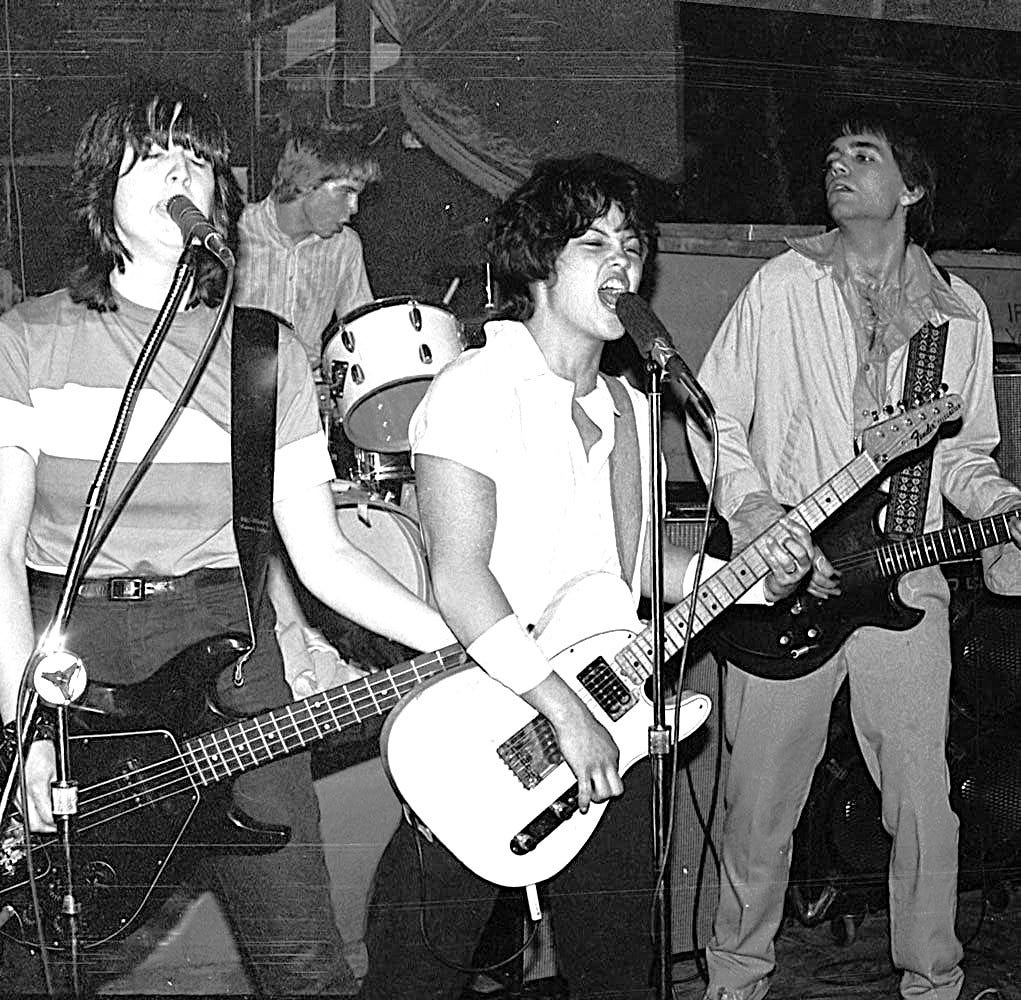
The Fastbacks with Duff on drums in 1981. Photographer unknown.
Zipdads Live Shows
It’s been possible to document eight known Zipdads shows between December 1980 and July 1981. In 1980-1981, the Zipdads played shows at least seven shows at the Gorilla Room, a small club near Pioneer Square, including several shows with the Fastbacks, RPA, and PsychoPop. The number of shows the Zipdads played with the Fastbacks was probably because at the time Duff was in both bands, playing bass in the former and drums in the latter.
PsychoPop
PsychoPop was Alan Anderson on guitar, Nick Scott on drums, and Tom Price on bass. They eventually broke up in mid-late 1981 mainly because Tom Price wanted to play guitar instead of bass, and musically wanted to go in more of punk rock direction, while Alan Anderson’s songwriting was more avant-garde pop or New Wave. Then PopDefect became Alan Anderson on guitar, Nick Scott on drums, and Charlie Hutchinson on bass. Meanwhile, in 1981 Tom Price formed the first lineup of the U-Men with Robin Buchan on bass, Charlie Ryan on drums, and John Bigley on vocals.
As Slats himself once told me, it was Nick Scott of PsychoPop/PopDefect who gave him the nickname Slats because of how skinny he was. In those days, it was considered important to have a punk rock nickname, but you couldn’t just choose one for yourself, it had to be given to by someone else in the scene.
The Gorilla Room
The Gorilla Room had been a restaurant known as Dine on the Green until it was taken over by the team of Tony Y. Chu (surname sometimes spelled Chew) and Bryan Runnings in May 1980. It was officially an over 21 bar, but it was notorious for not carding anybody and letting pretty much anybody come in to see the shows, and drink as well. One trick of the trade for underage drinkers then was that if you were under 21, but you were a musician playing in a band, you could fill out an official form that said you were an underage musician, which would allow you to legally get into the club, but you still weren’t supposed to be drinking alcohol in there. This open door policy eventually got them in big trouble when the Washington Liquor Control Board raided the place in late July 1981, during which they caught both Andy Fortier and Duff McKagan illegally drinking beer while under age, resulting in the place losing its liquor license and getting shut down on July 23rd. Somehow Tony Y. Chu (Chew) re-emerged a couple years later in December 1984 to open the similarly named but all ages live music venue the Gorilla Gardens in an old movie theater in Chinatown.
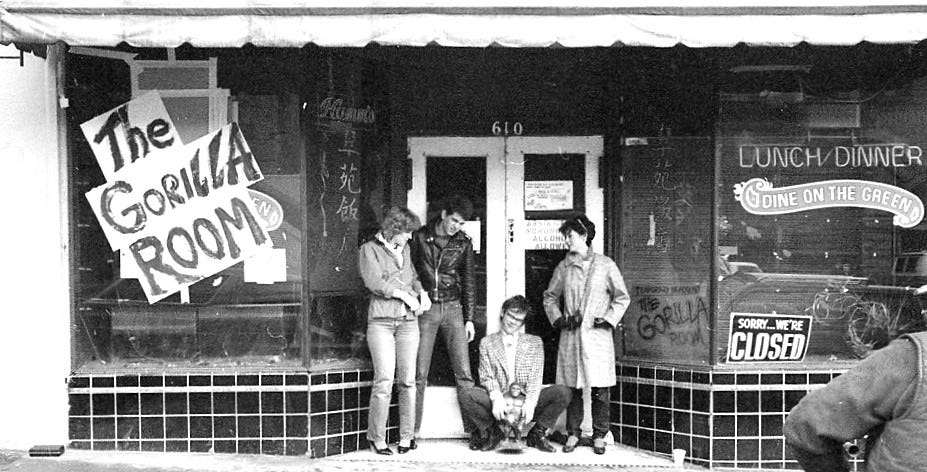
The Gorilla Room in 1980. From the archives of William Swan.
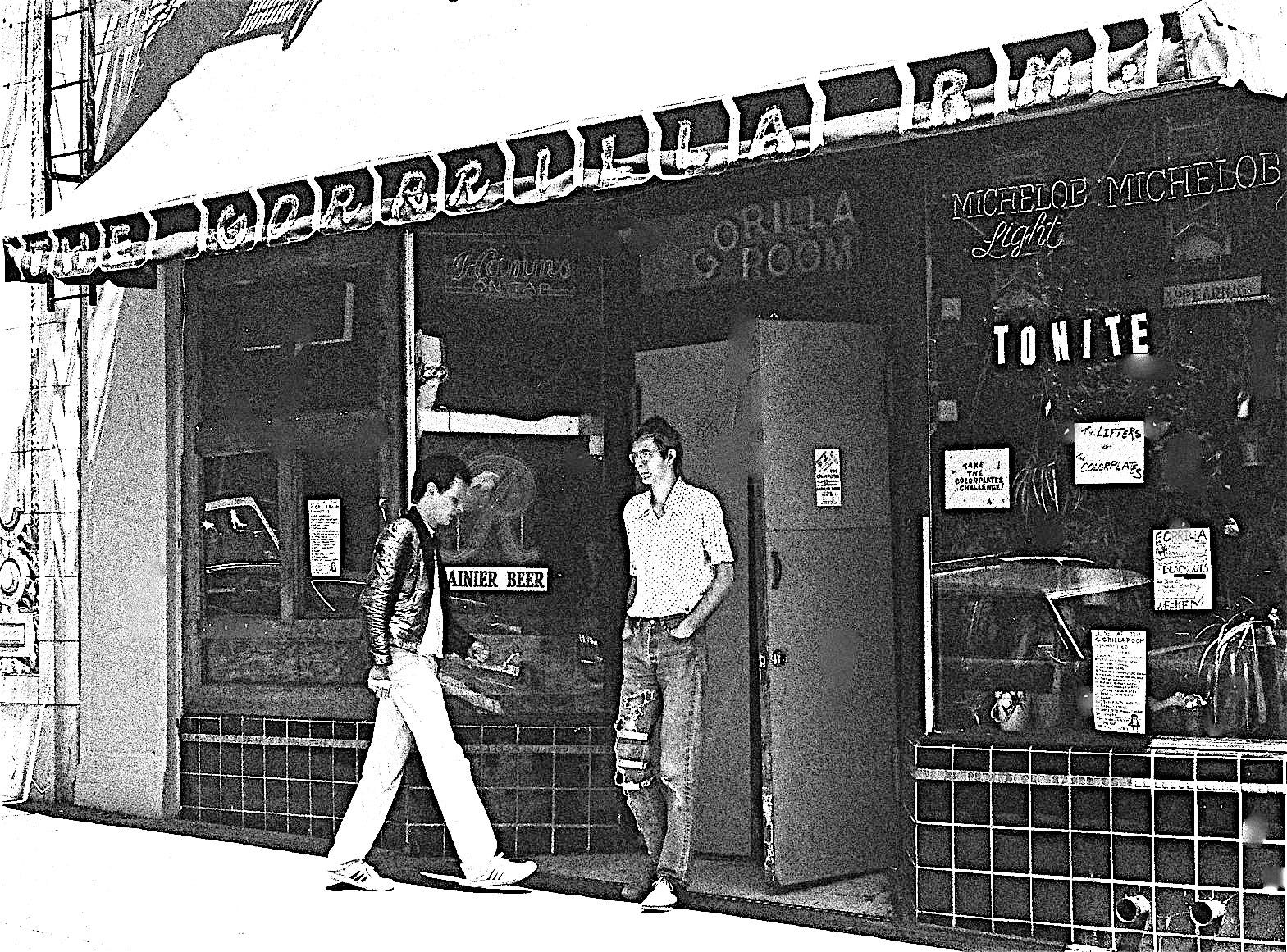
The Gorilla Room in 1980-1981. Bryan Runnings walking out the door, Ric Wallace walking in the door. Photographer unknown.
The Zipdads Live Shows
The Zipdads first known show was at the Gorilla Room on Sunday, December 28, 1980. The poster showed individual photos of all four members, who were identified by captions as “Scrap,” “Slats,” “Andy,” and “Bobo.” Slats was obviously Chris Harvey, while Andy was simply Andy Fortier using his real name. “Scrap” and “Bobo” must have been Duff McKagan and Scott Dittman, but it’s not clear which was which, as neither normally used either of those nicknames.
In the first half of 1981 the Zipdads continued to play a half dozen more shows at the Gorilla Room. On January 14, 1981 they opened for the Fastbacks there. They played the same club again later that month on January 21st with the Fastbacks and Joe Despair. This was their second of two shows with the Fastbacks. On February 23rd the Zipdads opened for RPA at the same venue. On Sunday, May 10, 1981, which was Mothers’ Day that year, the Zipdads played with RPA, Joe Despair, and the Lewd. This was their second show with RPA.
The Lewd had formed in Seattle in August 1977, but had moved down to San Francisco in mid-1979 and were now visiting from out of town. By this time the singer Satz was the original member left, and Bob Clic had taken over Brad Ramels old spot on guitar.
By this time, Brad Ramels had switched to playing bass in RPA, which also featured Doug Rockness, formerly the bass player of Solger, on vocals; Danny Bradshaw aka “Roach” on drums; and Randy Mauritzen on guitar. “Roach” was also the main drummer for the Refuzors throughout the 1980s, although he sometimes rotated with Gary “Wedge” Thompson, and played with another band called Wolfpack with Brad Ramels on guitar and Mike Refuzor on bass in the 1990s. RPA were founded in 1981, released one 7” single, “Shoot the Pope” b/w “Bonecrusher” in 1983, and somehow managed to continue on and off through 1985, when they did some shows at the Gorilla Gardens. The letters RPA supposedly stood for Raging Peasant Army.
On June 13, 1981 the Zipdads opened for Los Popularos at Danceland U.S.A., a club located upstairs at 1510 1st Avenue, in between Pike and Pine streets, about two blocks North of the Showbox Theater. Danceland was only open for about 8 months from the end of January to the end of August 1981. Los Popularos were a Canadian punk band active 1981-1983 which was kind of a super group merger of members of the Young Canadians, Pointed Sticks, and the Modernettes. The 1981 lineup included Art Bergman of the Young Canadians on guitar and vocals, John Armstrong (aka Buck Cherry) of the Modernettes on guitar and vocals, Tony Bardach of the Pointed Sticks on bass, and Zippy Pinhead on drums.
The height of the Zipdads was probably when they got to open for Husker Du at the Gorilla Room several nights in a row on July 9th and 10th, 1981. There are several surviving gig posters for this tour. This was the Minneapolis band’s very first ever West Coast tour and first ever visit to Seattle. Slats would get to open for Husker Du again in 1982 with his band the Silly Killers at Dez’s 400.
Unfortunately, the Zipdads never got to release anything during their brief existence, and no recordings of any kind are known to exist now. However, there was a contemporary press report in the Seattle Times on February 7, 1981 that said they had submitted a tape of some sort to Stephen Rabow of radio station KZAM, known as the “Rock of the ‘80s.” Besides a few gig posters and club ads, their only tangible documentation is one band photo that was taken in a record store on the Ave, where Andy Fortier can be seen holding a record by, or maybe a poster of, the local band Alley Brat, while Scott Dittman dramatically spits on it, and Duff and Slats look on.
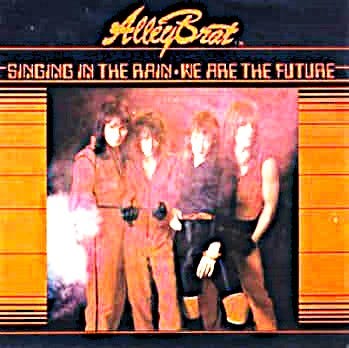
It’s hard to tell from the photo, but it could be a copy of Alley Brat’s 1980 single “Singing in the Rain” b/w “We Are The Future,” or a poster advertising their February 1981 shows at the Showbox. Either way, the can band can clearly be seen in their matching red jumpsuits with their trademark slogan, “We Are the Future.” Chronologically, either of those items would fit into the Zipdads timeline.
Alley Brat were a notorious joke in the Seattle music scene, mainly because they played a very outdated 1970s style of rock music that was no longer in fashion, but were heavily promoted by some deep pockets financial backer who would pay for their matching outfits, full-color posters, magazine ads, put out two 7” singles for them in 1980, and even rented out the Showbox Theater for them to headline two nights in a row on February 20-21, 1981 at shows where they pretty much let anybody in for free. I was in high school in Burien at the time and I can still recall my classmate Dave Boles attending one of these Alley Brat shows in early 1981 and coming back to school the next day to tell me how bad they were and that “nobody paid” to get in. Despite being so cheesy, they advertised themselves as “We Are the Future,” which you can see on the item that Dittman is spitting on.
Meanwhile, in this one Zipdads photo, Slats still has short hair and can be seen wearing his black leather jacket reversed with the zipper-less back of the jacket on his front side and the sleeves in back, somewhat a homage to the photo of Leonard wearing a straight straight jacket on the cover of the Dickies 1978 “Paranoid” record. This one picture of the Zipdads dating from late 1980 or early 1981 was precious enough to Slats that a copy of it was found in his bedroom at the time of his death in 2010. He had kept it there close to him for 30 years as a remembrance of his first band, and the fact that he had once been in a band with Duff McKagan of Guns N’ Roses, something which he kept telling people in later life, but which others often didn’t believe.
After the Zipdads broke up in mid-Summer 1981, in the second half of 1981 Duff McKagan went off to join the Living, a new band started with his former band mate Criss Crass from the Vains, John Conte of the Missing Link on vocals, and Todd Fleischman on bass.
Scott Dittman and Andy Fortier went on to the Deans with Al Bloch of the Cheaters and Wenis on bass, and Pam Lillig of the Meyce and the Girls on guitar.
On December 31, 1981 the Deans played a show at 66 Bell Street, then the Enemy Studio, later the Lincoln Arts Center, with the Enemy and the Fastbacks, and a recording of the Deans set was released in April 2021 as a live album by Tom Dyer’s Green Monkey Records.
After the Deans Andy Fortier played with the Gestures and Tom Hansen’s band the Crotch Rockets, which I managed. Dittman went on to form a band called Know Tomorrow, with Todd Fleischman and Carl Barish.


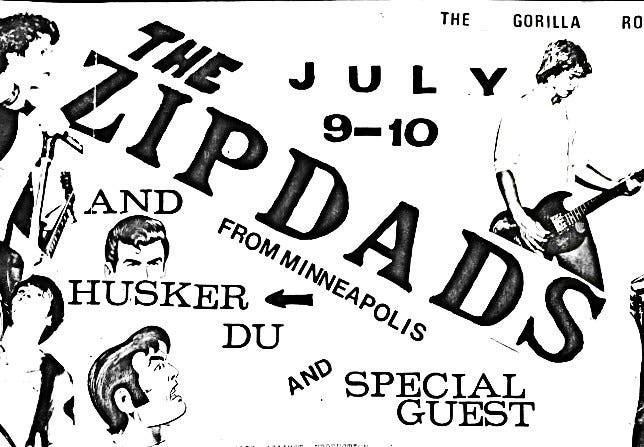
Above is a gallery of archival Zipdads photos and posters. Top left corner the Zipdads in 1980-1981. Photographer unknown. Found in Slats’ bedroom after his death by Blake Richardson.
II. The Silly Killers
In Slats’s second band, the Silly Killers, he continued to play guitar, using his Gibson SG, but was joined on lead vocals by Eddie Huletz, Gary Clukey on bass, and a high school friend named Tim Gowell on drums. Clukey was already a lot older than the other members, while the other three were about the same age. While Slats was from Montlake, Eddie was from Laurelhurst, a similarly upscale residential neighborhood just across the ship canal on the other side.
It’s been possible to document 24 shows that Slats’ second band the Silly Killers were at least booked to play over the roughly two years they existed between early November 1981 and early October 1983. Given the times, it’s possible that at least some of these may have been cancelled after they had already been publicly promoted, as is noted in each relevant individual entry.
Seattle’s Lack of Live Music Clubs & the Dependence on Rented Halls
During the 1980s, the Seattle music scene was cursed by the same chronic problem of a lack of long-term, stable clubs where bands could play. In particular, even when there was a club it tended to be an over-21 bar, and all ages clubs rarely existed. The few brief exceptions had been the Bird for about three months in March-June 1978, the Gorilla Room (over 21) in 1980-1981, the Showbox from Fall 1979 to Spring 1983 (a more complicated story than most realize, with Modern Productions only running it for one year from 1979 to 1980 and other promotion companies with a more mainstream booking policy from 1980 to 1982), Danceland U.S.A. for about eight months in 1981, and the Gorilla Gardens from December 1984 to Fall 1985.
Otherwise, if it weren’t one of those brief moments when there was a real club open, it was up to certain promoters like Maire Masco’s Holy War Cadets, Tony DSML, David Portnow, and me, or the bands themselves, to rent halls in order to put on all ages shows. With the changes in society going on at the time, there were a number of old fashioned organizations that owned meeting halls in the downtown urban area but had few meetings anymore, and so they would be willing to rent them out at a price of about $100 in order to keep up their mortgage payments and not have to sell the property. These organizations included fraternal orders such as the Masons, Moose, Elks, Eagles, and Oddfellows. There were also associations of ethnic immigrants, especially those from Eastern Europe, who owned their own halls, including the Ukrainians, the Serbians, the Polish, etc. And, there were employee labor unions of skilled workers who owned their own halls, such as the Seamen, the Carpenters, and the United Construction Trades (UCT).
So, in theory you could rent one of these halls, which in the beginning of the 1980s were still plentiful, but you would basically get an empty room with electricity, which hopefully had a stage, but you would have to rent your own P.A. sound system and soundman engineer to run it, as well as stage lights, hire security to make sure people paid to get in, make and put up the posters yourself, etc.
And, unfortunately, there were a lot of risks involved in these rented hall shows that could quickly cause a budding promoter to go bankrupt or give up. For example, some people, such as the Bopo Boys, would always try to find ways to sneak into the show for free without paying, through the fire exit, a back door or freight elevator that the bands used to load their gear in and out, or climbing through a bathroom window, thus reducing your income. Meanwhile, other people, often the same ones who snuck in, would damage the venue by punching a fist through the wall, breaking glass windows, leaving empty booze bottles all over, setting the place on fire, etc., as a result of which you wouldn’t get your $50.00 damage deposit back from the landlord, who would also refuse to ever rent the space to you again, forcing you to look for another new venue to rent for the next show, and so on. And, the threat of people sneaking in without paying or damaging the place and causing you to lose your deposit in turn made you hire private security teams such as the Fallen Angels, who were comprised of a bunch of mostly Black and Asian guys who went to Garfield High School, such as Damon Gayden and Mike Su, and dressed up in some kind of vintage WWI army uniforms, which then became another built in cost of putting on a show, since they weren’t going to work for free and charged at least $10.00 each per night, and you would need more than one of them, basically one guy had to watch every possible entrance to the venue.
As an alternative, you could try booking the show at an over 21 bar that already had its own house P.A., soundman, stage lights, and doorman, and was willing to cooperate, which at times places like Bugsy’s, the Bahamas, the Gorilla Room, Wrex, Dez’s 400, the Vogue, the Golden Crown, and the Ditto were, but the vast majority of the people in the punk scene were under 21 until at least 1986, thus reducing the number of people who could attend your show along with the overhead costs. This was a continuing dilemma that I personally, as a promoter and band manager, was never fully able to resolve, alternating back and forth between the two imperfect choices of type of venue.
1. The Silly Killers First Show
On Friday November 6, 1981 the Silly Killers opened for the U-Men and AAIIEE!!! at an all local all-ages show at the Laurelhurst Community Center. Laurelhurst was then an upscale residential area where Eddie Huletz and his family owned several houses, so he probably used his family connections to get the venue. Todd Fleischman of the Living and Silly Killers II also lived in the Laurelhurst area.
This is usually considered to be the Silly Killers first show. Online rumors that they supposedly played an earlier show opening for the Vains at the same venue in “Fall 1981” aren’t supported by any evidence, there is no surviving gig flyer, and Criss Crass of the Vains has told me that it never happened.
Participants such as Jeff Larsen of AAIIEE! recall that a bunch of jocks showed up to cause trouble and ruin the party, a riot ensued, and in turn the neighbors called the cops, with the result that this was the last show venue allowed. And so, the Silly Killers saga somewhat appropriately started with a riot.
This was the first of three times that the Silly Killers played with the U-Men during the first five months of their existence. In all three cases this was the lineup of the U-Men with the girl Robin Buchan on bass, since Jim Tillman didn’t join until 1983. The U-Men’s guitar player Tom Price was Slats’ childhood friend, so this could explain the frequency of shows that the Silly Killers played with the U-Men.
Incredibly, over 40 years later, in 2024 AAIIEE!!! are still playing live shows in Seattle clubs, albeit with Johnny Vinyl and Jeff Larsen as the only two original members, joined by Greg Stumph, and currently rotating drummers.
2. The First St. Joseph’s Hall Show
On December 11, 1981 the Silly Killers opened for the Fastbacks and the Living at an all local, all ages show at Saint Joseph’s Hall, located at 18th Avenue E. and E. Aloha St. on Capitol Hill in Seattle.
The Zipdads had previously played with the Fastbacks at least twice in the first half of 1981, and this was the first of four shows that the Silly Killers played with the Fastbacks in 1981-1983, so clearly Slats had a close relationship with Kim Warnick and Kurt Bloch, who later released their 1982 7” single on his No Three’s record label.
This was also the first of five shows that the Silly Killers were scheduled to play with the Living, probably because Eddie Huletz and Duff McKagan were and are still best friends for life. By this point, Duff was out of the Fastbacks, replaced by Richard Stuverud on drums, and he was now in the Living. This was the first lineup of the Living with Criss Crass and Duff, who had both been in the Vains together, rotating and switching off positions as drummer and guitar player in the course of a typical live set on stage. Throughout the history of the band in 1981-1982, Todd Fleischman remained the band’s bass player and John Conte was always their singer, but at some point in 1982 Criss Crass was replaced on drums by Greg Gillmore and the drums-guitar rotation schtick stopped.]
3) The Arcadian Hall Show in Vancouver, B.C.
On Tuesday, December 29, 1981 the Silly Killers opened for the Fastbacks and D.O.A. at a big all-ages show at Arcadian Hall, located at Main St. and 6th, in Vancouver, B.C., Canada. This show was widely promoted by Canadian newspapers, including The Province on December 17 and 18th, 1981, and the Vancouver Sun on December 24th . According to the December 18th article in The Province newspaper, despite being on a Tuesday this show was expected to have a high turnout because it was D.O.A.’s first all-ages show in their hometown of Vancouver, B.C. in the 10 months since February. Although people didn’t know it then, it was also the second to last D.O.A. show to feature the classic rhythm section of Randy Rampage on bass and Chuck Biscuits on drums, since Rampage got fired immediately after their December 31st 1981 show at the Smilin’ Buddha on New Year’s Eve.
This was only the Silly Killers third show ever, and it’s pretty amazing that after only two shows in their hometown of Seattle, WA, they were already playing in a foreign country. It was also their second show in a row with Fastbacks, who must have been instrumental in getting them the gig.
Although he had ridden up there to Vancouver, B.C. with the rest of the band, the Silly Killers first singer Eddie Huletz somehow missed the show, that was described to me by Slats as having an audience of 1,000 people and being the biggest show he ever played in his life. The reason for his absence is debatable. He may have been advised that the show would start later, but because it was an all-ages show it started earlier. In the meantime, during his absence, the band simply handed the lyric sheets to some total stranger from the audience and they went on stage, played their set, with this substitute singer. Eddie didn't show up until he mysteriously reappeared at the venue again after the show was already over. It must have been a long cold ride home back to Seattle.
My version of this story is mainly based on what I heard from Slats. Slats was still pissed off and bitter about this incident when he told me the story several years later. He said it was the biggest show he had ever played in his life and that Eddie had totally ruined it for him.
At that time, my understanding was that this incident had caused Eddie to get fired from the band, but chronologically this seems impossible now that I’m able to cross reference all the relevant dates. Eddie was clearly still in the band in March-April 1983.
However, it certainly was the first of a series of incidents to create some bad blood between Eddie and Slats. Other contributors to this were probably that Eddie did later quit the band, circa May 1983, and that Slats decided to continue without him. When I saw the two in the same room circa 1984-85 it was clear that there was still some tension in the air and no real warm affection.
4) The UCT Hall Show
On Friday, January 22, 1982, the Silly Killers played an all local all-ages rented hall show with the U-Men at the UCT Hall on 5TH and Aloha. This was their fourth known show, only their third one in Seattle, and the second time they had played with the U-Men.
UCT Hall was always sort of hallowed ground for me personally. The full name stood for United Construction Trades Hall. It belonged to a somewhat dormant tradesmen’s association that didn’t really need it for their meetings anymore but didn’t want to sell it either, so they would rent it out for $100 a night, plus a $50.00 deposit, but you had to bring your own P.A. sound system and soundman, which would cost you another $75.00.
Some other writer once described it as being “shabby” but it was a castle to me. The square-shaped building had no windows, so the sound of music couldn’t get out and bother the neighbors, nor was there a way to sneak in, although it had two entrances, one on each front corner. There was a stage in front of the main room, and a fully equipped kitchen in the back with a full-size refrigerator where you could keep all your beer cold. As another sign of the times, installed on the way there was an actual public pay phone that you could call if you wanted to find out what was going on down there and if there were a show somebody would answer it.
As mentioned earlier, the proto-Fastbacks band The Cheaters played their last ever show ever here on Friday, October 26, 1979. Later I booked On The Rocks to play here on New Year’s Eve December 31, 1984. After the Gorilla Gardens closed its original Chinatown location, Tony DSML briefly turned it into the UCT Skank Hall, and David Portnow started promoting shows there, too. I set up a show for Debutante to open for Strychnine here in 1986. Later in 1986 I attended the two Deep Six shows here, where I got to see an early version of Soundgarden with Hiro on bass, as well as the U-Men and Malfunkshun. It was the most memorable, although not the only, time I ever saw Malfunkshun, who were all dressed in their white pancake face makeup.
5) The Scissors Show
On February 5, 1982 the Silly Killers opened for the Canadian punk rock band the Scissors at the all ages rented hall known as Polish Hall located at 18th Avenue E. and E. Madison St. on Capitol Hill in Seattle.
The headlining band’s name was spelled wrong on the poster as “Sissors,” with no letter c. The Scissors were a four-piece Canadian New Wave band from Vancouver, B.C. who released one six-song, 12” vinyl E.P. in 1982.
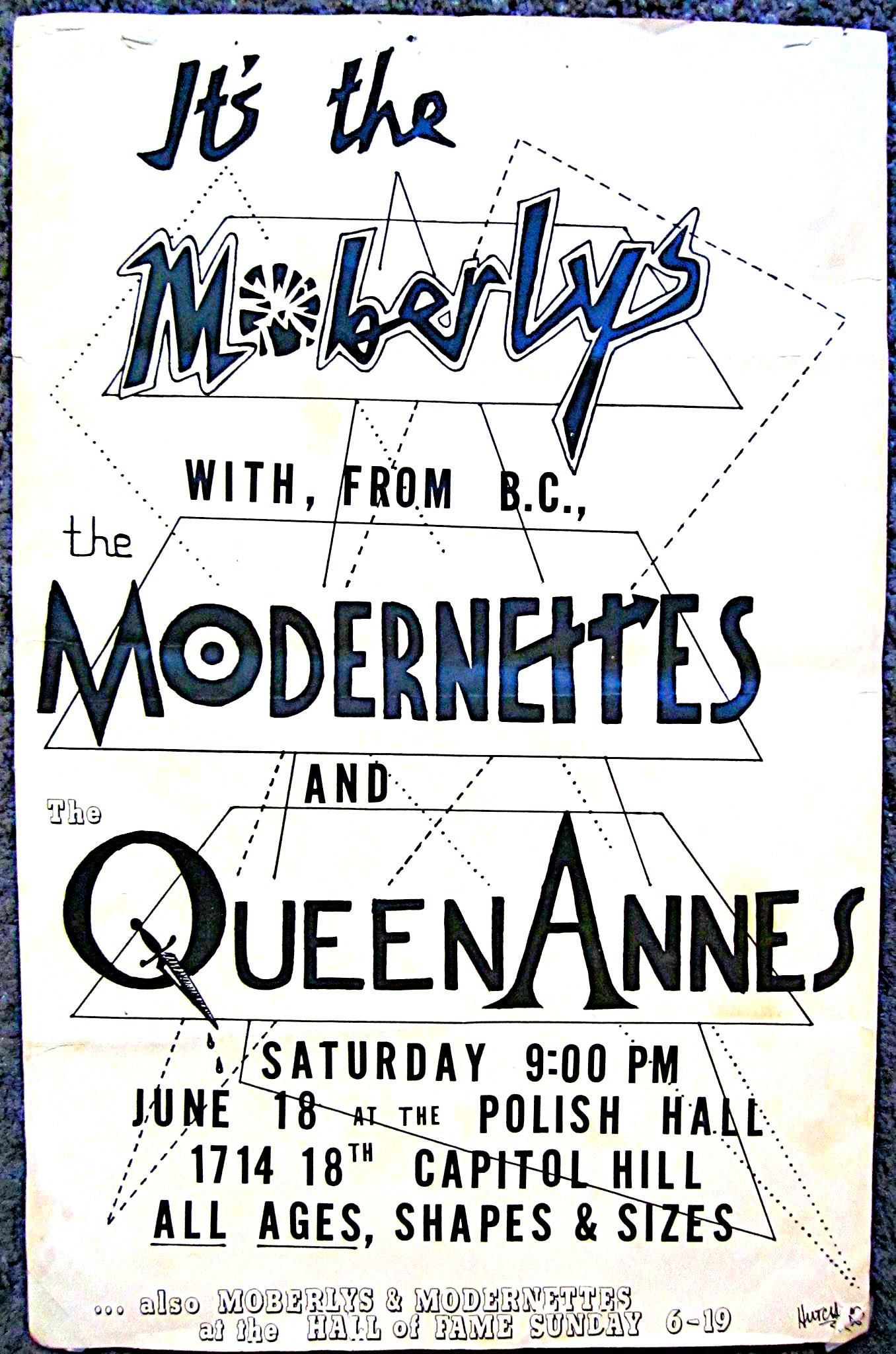
This was one of those halls owned by an association of ethnic immigrants, such as the Ukrainians, the Serbians, the Poles, etc., who didn’t really need it for their meetings anymore but didn’t want to sell it either, so they rented it out. Polish Hall was the same rented hall where I later saw Jim Basnight and the Moberlys open for the Modernettes on Saturday June 18, 1983. At that time the Moberlys were a trio with Jim Basnight being backed up by Al Bloch on bass and Dave Dave Drewry. They had just moved back to Seattle from an ill-fated attempt to relocate to NYC in 1982.
The Modernettes were a Canadian trio led by guitar player/singer John Armstrong, aka Buck Cherry, that in 1980 had released an E.P. I had called “Teen City,” as well as a second E.P. called “View From the Bottom” in 1982, and were sort of reminiscent of Johnny Thunders and the Heartbreakers; certainly they had a fascination with NYC, but broke up by the end of 1983 without having achieved any commercial success. John Armstrong later made a lot of money by licensing his nickname “Buck Cherry” to the major label hard rock band of the same name that formed in 1995.
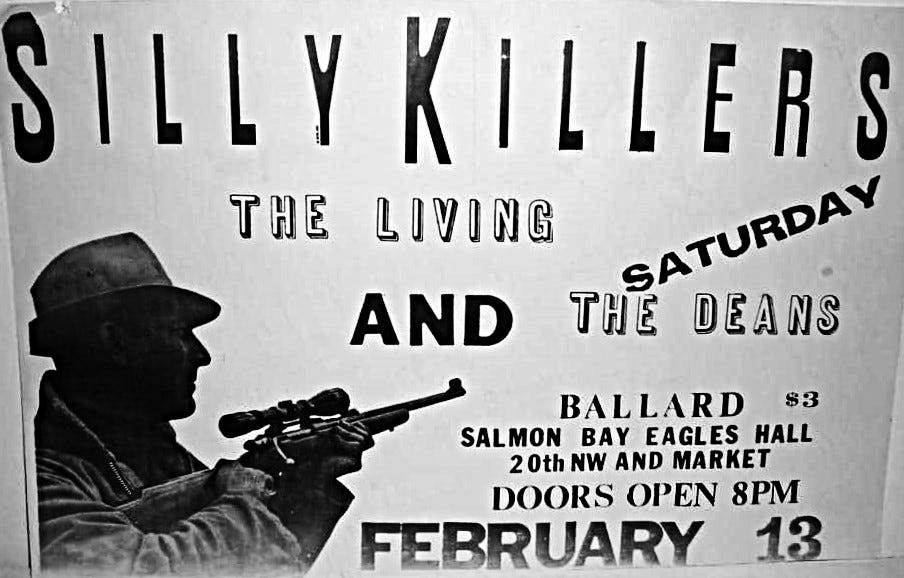
6) On Saturday, February 13, 1982 the Silly Killers headlined an all ages show at a rented hall known as the Salmon Bay Eagles Hall located at 20th NW and Market in Ballard with the Living and the Deans opening for them. All three bands on this bill featured all four former members of the Zipdads, with Slats in the Silly Killers, Duff McKagan in the Living, and Scott Dittman and Andy Fortier both in the Deans.
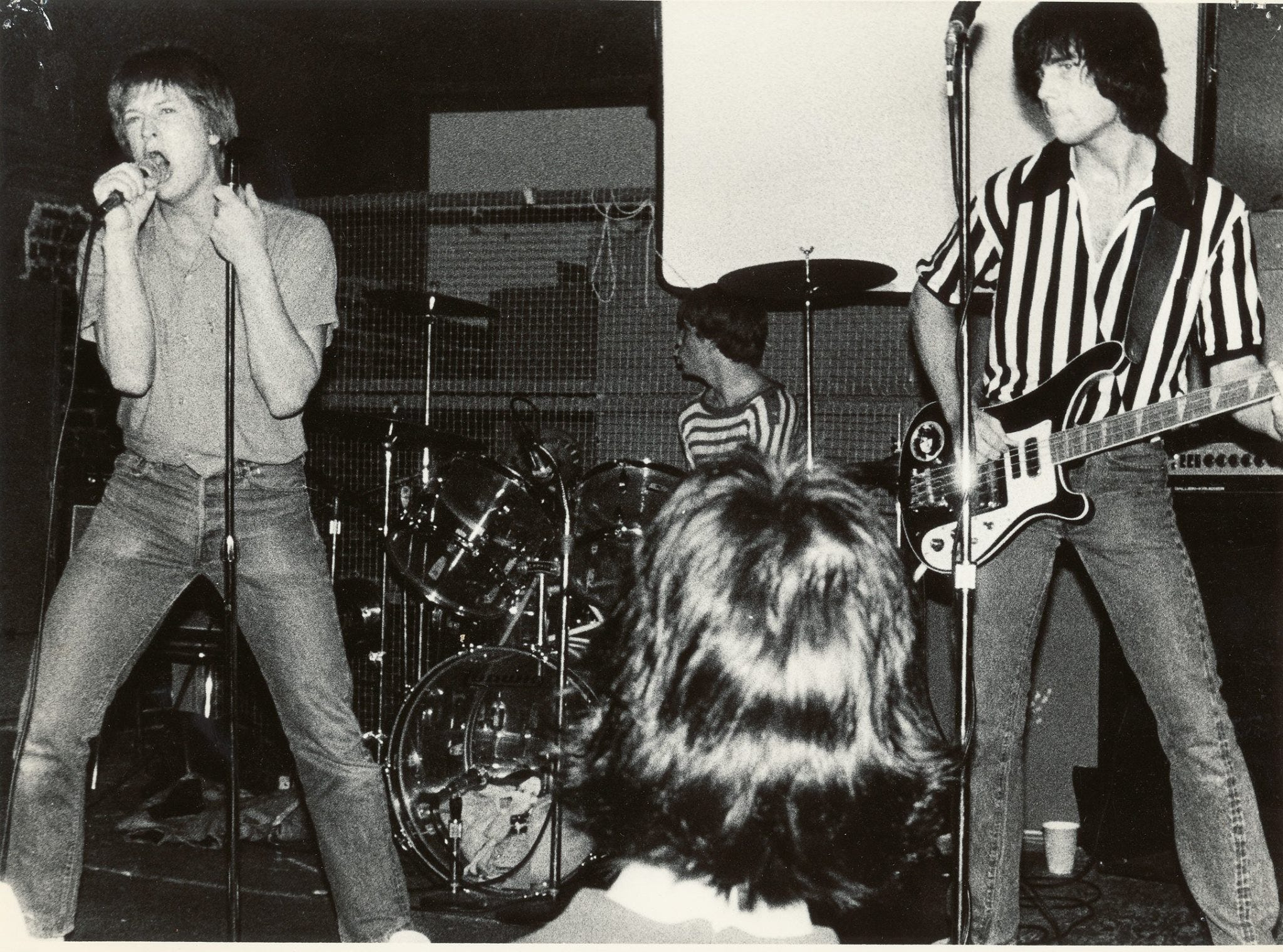
The Deans in 1982. L-R Scott Dittman (vocals), Andy Fortier (drums), Al Bloch (bass). Not shown Pam Lillig (guitar). Photographer unknown.
7) The First Smilin’ Buddha Show in Vancouver, B.C.
On February 19-20, 1982, the Silly Killers supposedly drove up to Canada for a second time to play a show at a fairly small over-18 bar (the drinking age was only 18 up there) called the Smilin’ Buddha located at 109 E. Hastings Street in Vancouver, BC. This was the same venue where D.O.A. had played their December 31, 1981 New Year’s Eve show, the last one with the classic rhythm section of Randy Rampage and Chuck Biscuits, less than two months earlier. Although the Silly Killers had kind of blown it at their first show in Canada at Arcadian Hall in December 1981, when singer Eddie Huletz mysteriously missed the show, for some reason they were asked to come back again two months later to headline two nights in a row at this much smaller club. Also strange is the the two opening acts were the fairly unknown local Canadian bands Immortal Majority and Contraband. Slats never told me about these shows, so I’m not sure how well they went, or if they even happened for sure.
I’m still not totally sure if this show actually happened or not because Slats never mentioned it to me, and I recently asked Eddie Huletz about it but he hasn’t replied yet.
8) The Oddfellows Hall Show
On March 2, 1982 the Silly Killers played an all local all-ages show at the rented IOOF Oddfellows Hall located at 915 East Pine Street on Capitol Hill in Seattle. The two other bands on the bill included the Accused and the Bootboys. From the billing on the gig poster, it seems that the Accused were headlining, the Bootboys were opening, and the Silly Killers were playing in 2nd place in the middle between the two other bands.
A surviving poster for this show has been posted in the PNW Music Archives Facebook group, where the person who posted it mistakenly dated it as supposedly being 1984, which caused all sorts of other mistaken confusion in the post’s header text and many comments about the Silly Killers lineup, etc. The fact is that this show was in 1982, not in 1984. There was no Boot Boys in March 1984, as they had broken up in 1983, and Duff did not play drums for the Silly Killers at this show, Tim Gowell did. So, there.
This was another rented hall owned by a somewhat dormant fraternal order such as the Elks, the Moose, the Eagles, etc., who didn’t really need it for their meetings any more but didn’t want to sell it either so they rented it out. The abbreviation IOOF stood for the International Order of Oddfellows. This was the same venue where the legendary Mentors/Lewd show took place in May 1978, and it was where the Bird-in-Exile relocated after their original location downtown on Spring St. was shut down by the cops.
To repeat, this was the original lineup of the Silly Killers with Eddie Huletz on vocals, Slats on guitar, Gary Clukey on bass, and Tim Gowell on drums. Duff McKagan did not play this show!!!
This was the original lineup of the Accused with their first singer John Dahlin still on vocals, Chewey on bass, Dana Collins on drums, and Tom Niemeyer on guitar. It was the same lineup that appeared on their 1983 split LP with the Rejectors, “Pardon Our Noise…It’s the Sound of Freedom.” Blaine Cook would not replace Dahlin until the Summer 1984 and Alex Sibbald did not replace Chewey on bass until the end of 1986, after he quit Slats’ band Cheating Death.
The Boot Boys featured Carl Barish (1962-2021) on guitar, Rick Dorgan on drums, and John Dailey, aka “Dee,” on bass. Carl and Rick were both known for sporting spikey tall mohawk haircuts, with the top of Carl’s Mohawk sometimes hitting the ceiling if he jumped too high while playing on stage. The Boot Boys broke up in around mid-1983 and by the Fall of 1983 Rick had joined Loud Fart’s band Cannibal.
The story Carl Barish always told me about why the Boot Boys broke up was because he didn’t want them to record or release anything, being afraid that it would sound too band and thus ruin the band’s myth, but the other members did. Eventually, after his death in 2021 his brother Paul Barish released the Boot Boys only known recording, a seven-song basement tape recorded on a four-track, which Carl had kept secret for decades, featuring their one big hit song, “Tennis Shoe Lad.” https://www.reverbnation.com/bootboysseattlepunk
Carl and Slats became very close friends and remained so throughout the 1980s, often hanging out and drinking together. They formed a sort of joke spare change team called “the Robe Warriors,” that would wander around the U-District asking for spare change from passersby in exchange for letting the payer watch them punch each other. Carl’s brother Paul Barish later became the singer for Slats’ band Cheating Death in 1986. Rick and ? of the Boot Boys later formed a band with Carl’s brother Paul Barish in the 1990s called The Suffocated.


The Boot Boys: 1) Rick and Carl, 2) Carl Barish, 3) Carl Barish. Photographer unknown. From the collection of Paul Barish.
9) The Serbian Hall Show
On March 12, 1982 the Silly Killers played an all local, all ages show at a rented hall known as Serbian Hall located at 4352 15th Avenue S. on Capitol Hill in Seattle. The other five bands on the bill seem to have included Malfunkshun, the Maggot Brains, Extreme Hate, the Rejectors, and the Fartz, although there is no surviving gig poster that I’m aware of. The show was reportedly a “Benefit for Seattle Child Abuse Clinic.”
This show was reviewed in the April 1982 issue of Attack fanzine #3, in which a lot of the band names were unfortunately misspelled. Malfunkshun’s name was spelled wrong as “Malfunktion,” and the Maggot Brains were mistakenly called the “Extreme Maggots,” a name which no band in Seattle ever used. Based on this one fanzine review, it seems that the Fartz headlined the show by playing last, while Malfunkshun opened the show by playing first, followed by Maggot Brains second, Extreme Hate third, Silly Killers fourth, and Rectors going on sixth, providing direct support to the Fartz. https://www.dementlieu.com/users/obik/arc/mrepp/attack3.html
The show is also listed on setlist.fm under the names of three of the bands, the Fartz, the Silly Killers, and Malfunkshun, even though no actual setlists are provided and no recordings of their sets are known to exist, but at least these entries serve to help confirm the date of the show, the venue, and the lineup.
https://www.setlist.fm/festival/1982/benefit-for-seattle-child-abuse-clinic-1982-2bd720ca.html
https://www.setlist.fm/setlist/the-fartz/1982/serbian-hall-seattle-wa-6b9142b6.html
https://www.setlist.fm/setlist/silly-killers/1982/serbian-hall-seattle-wa-739142b5.html
https://www.setlist.fm/setlist/malfunkshun/1982/serbian-hall-seattle-wa-7b9142b0.html
The Henry Rollins-fronted lineup of Black Flag later played their last Seattle show here on May 31, 1986.
This March 12, 1982 show would have featured the Fartz lineup with Paul Solger on guitar, and Lloyd Shattuck (aka Loud Fart) still on drums. The Fartz original guitar player, Tom Hansen (1961 – 2023), had played his last show with the Fartz when opening for the Dead Kennedys at the Showbox on July 12, 1981, and briefly been replaced by Criss Crass of the Vains at one Fartz show in the Summer of 1981 opening for D.O.A. at Danceland, U.S.A.
There could not have been two bands on one bill named Extreme something or other, and there’s no ever evidence that there was ever a Seattle band called
“Extreme Maggots,” although there was a band called Extreme Hate, so that has to be a mistake. Probably it was Alex Sibbald’s Maggot Brains, not “Extreme Maggots.”
The Maggot Brains
The Maggot Brains were a three-piece band that was notable for the unusual fact of not having any guitar player. Alex Sibbald played bass, while Steve Porhad sang, and a guy known only as Fred played drums. In 1980-1981 the Maggot Brains played shows at the Gorilla Room, Danceland U.S.A., the Showbox, the Enemy Studio at 66 Bell, and various all ages rented halls. In the Summer of 1981 they recorded a five-song demo tape in Wallingford that was produced by Harry Kool, who had appeared on the cover of the first issue of the Rocket in 1979 and later produced the 1984 Ten Minute Warning album that wasn’t officially released until 2021.
Alex Sibbald
Alex Sibbald was so good at playing bass that he could play leads like a guitar player would, playing his bass while holding it in the upright position, rather than slung down low below his waist. He was considered sort of the Lemmy or Chuck Dukowski of Seattle, and it was often said he was too good of a bass player to play in a band with a guitar player, until he joined Slats’s bands Itchy Brother in 1985, Cheating Death in 1986, the Accused in 1987, and eventually he finally actually switched to playing guitar in the 21st Century, first in a revived reformation of the Fartz after Paul Solger had quit, and later in the Accused A.D. Alex was also sort of unique in the scene for being pretty straight edge. He very rarely drank alcohol and unlike a lot of other people in the scene he never became a drug addict. The only time I ever saw him drink a beer was backstage at an Accused show at the Pine Street Theater in Portland, OR when S.G.M. opened for them in 1988 or 1989. When I caught him drinking he actually seemed embarrassed by it, it was like “busted.” Alex was also notable for maintaining a very short haircut with an almost shaved head throughout the whole decade of the 1980s, even after long hair started become fashionable again by the end of 1986, the year I usually consider to mark the end of punk, when all the members of Tom Hansen’s band the Crotch Rockets had long hair, and so did I even. He was one of the last Seattle musicians to finally succumb to the long hair fashion during the Grunge mania of the 1990s, probably under the peer pressure of other members of the Accused.


Three photos of the Accused with Alex Sibbald (bass): 1) 1987, 2) 1988, 3) 1989. Photographers unknown.
The Rejectors
The Rejectors were the only punk rock band to ever come out of the southern suburb of Burien. They featured Gerry Irwin on bass, Dave Farness on guitar, Bruce Fogg on vocals, and Scott Russell on drums. Their lyrics were very left-wing political and the music was very fast hardcore punk. They had a 7” single called “Thoughts of War” on “Fartz Wreckords” in 1982 and shared a split album with the Accused in 1983, with their half being called “Through My Mind’s Eye,” but the album usually being known by the name of the Accused’s side, “Please Pardon Our Noise…It’s the Sound of Freedom.”
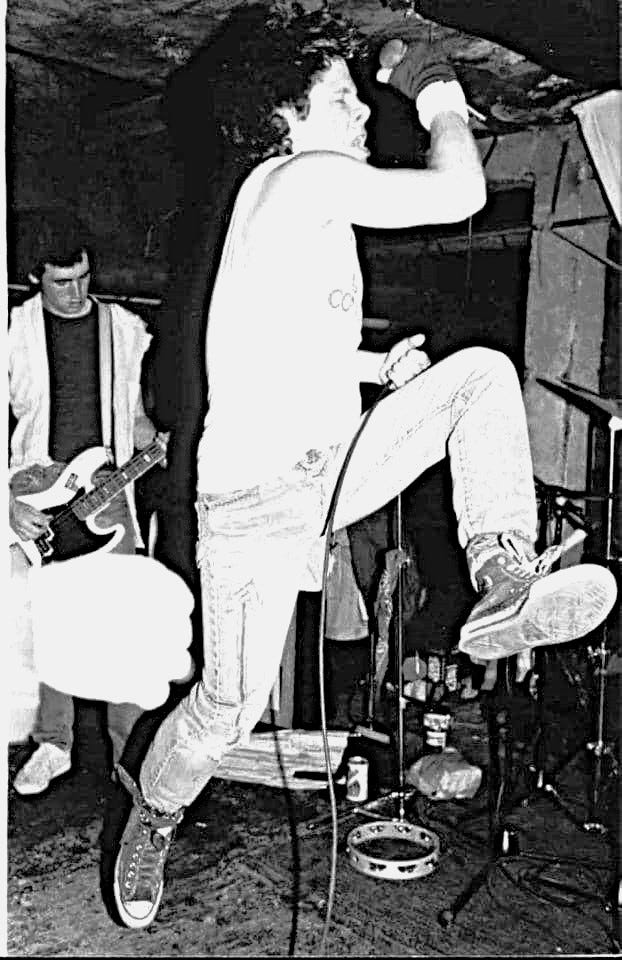
The Rejectors’ Bruce Fogg (vocals) and Gerry Irwin (bass) circa 1982. Photo by Carlene Heitman.
Malfunkshun
Malfunkshun were, of course, Andrew Wood (then known as “L’Andrew the Love Child”) on bass and vocals, his brother Kevin Wood on guitar, and Regan Hagar on drums. Formed in 1980, they broke up in early 1988 when Andrew Wood joined Mother Love Bone. During their long eight-year lifetime, they made many home recordings but only managed to release two songs, “With Yo Heart (Not Your Hands)” and “Stars N’ You,” both on the 1986 “Deep Six” compilation put out by C/Z Records. For the first few years after they started out they played shows with all the hardcore punk rock bands, even opening for the Fartz and Discharge at the Showbox on September 29, 1982, and opening for Husker Du at the Metropolis in 1983, even though their own image and sound harkened back to the ‘70s hard rock of Kiss, with all the members wearing white pancake makeup and lipstick, and Andy starting the shows by yelling out to the audience “Hello Seattle!” as if they were some national touring act playing the Coliseum.
10) The Second St. Joseph’s Hall Show
On March 19, 1982 the Silly Killers played their second all ages show at Saint Joseph’s Hall located near the intersection of 18th Avenue E. and E. Aloha Street on Capitol Hill in Seattle. The three other bands on the bill included the U-Men, the Refuzors, and Joe Despair & the Future. Based on the gig poster, it seems that the U-Men actually had to play first, followed by the Silly Killers in 2nd place, then the Refuzors third, and Joe Despair and the Future headlining. The ticket price was $3.50, less than $1.00 per band.
This show was photographed by Mike Leach & the photos are still available on his website. https://www.bestrockphotos.com/Silly%20Killers/1982_2/index.html.
From these photos we can see that Slats and Clukey were both wearing black leather jackets, but otherwise their appearance didn’t fit what became the stereotypical image of punk. Neither has a blue mohawk, for example. From the photographs taken of the show by Mike Leach, we can see that Eddie Huletz, Slats, and Clukey all three had short hair. Eddie’s head is almost shaved, and he was drinking cans of beer while singing on stage. The band had their own Igloo ice chest that they would use to take supplies of beer to their shows, with “Silly Killers only” written in marking pen on top of its white lid (Eddie still had this when I was hanging out his house in Laurelhurst in 1984 while I was managing his band On The Rocks). Slats is sporting a pair of long sideburns, and no hat or scarf yet over his head. Clukey has a pretty normal looking short haircut that wouldn’t have been out of place in an office, probably because he had a day job working at a law firm and couldn’t afford to look too weird. His bass has a big sticker on it for The Damned. One of the guitar amplifier cabinets had the Silly Killers crucifix logo on it.
This was the third and the last time that the Silly Killers are known to have played with the U-Men, who still featured Robin Buchan on bass.
Tom Hansen
Interestingly, the Refuzors at this time featured two guitar players, including original Fartz guitar player Tom Hansen (1961 – 2023), along with Ward Nelson. Later, in the Summer of 1983 Tom Hansen and Eddie Huletz would join forces to form the Miserables, who later changed their name to On The Rocks. The two played together from 1983 to 1985. Even later, Tom Hansen and Ward Nelson would reunite as dual guitar players in Crisis Party II from 1987-1989.
Even though his then current band the Living weren’t playing that night, the photographic evidence still shows that Duff McKagan felt the need to get up on stage and sing a duet with Eddie Huletz, which was sort of a testament to how close their friendship was, and still is today.
11) The Recording of the Silly Killers 1982 Single
In March 1982 the Silly Killers recorded at American Music the four songs that would later appear on their debut 7” vinyl single released by Kurt Bloch’s record label No Threes in December 1982, including “Not That Time Again,” “Knife Manual,” “Social Bitch,” and “Sissie Faggots.” It was produced by Eric Barger. They got the same deal as the Vains had when they recorded their single here in 1980; in exchange for spending a minimum amount of money buying a P.A. and/or other musical equipment, they could get free studio recording time and a limited number of 7” vinyl singles pressed for them, too. The main musicians were still the original four-piece lineup, but Duff McKagan sang backup vocals. Interestingly, all the songwriting was credited to Chris Harvey (aka Slats) and Gary Clukey, while Eddie Huletz received no individual songwriting credits.
It’s not known whether or not there were any other unused outtakes from this session. Two other Silly Killer songs appeared later on the “What Syndrome” cassette-only compilation in April 1983, but since Duff was on drums on those tracks they must have been recorded much later after he temporarily became their drummer on March 1, 1983.
12) The Mural Amphitheater Show
On May 1, 1982 the Silly Killers played an outdoor show at the Seattle Center’s Mural Amphitheatre. There is no surviving poster or flyer but there is at least one surviving photograph of the Silly Killers on stage.
13) The 1982 Husker Du Shows
On Tuesday, June 8-Wednesday, June 9, 1982 the Silly Killers were scheduled to play two nights in a row at Dez’s 400 on Mercer St. with their buddies The Living. On the first night, the 8th, the Silly Killers were opening for Minneapolis band Husker Du, who did not play the 2nd night.
This was only the second time Husker Du had been to Seattle, the first having been a series of four shows they played here in 1981. Since Slats’ previous band the Zipdads had already opened for Husker Du twice before at the Gorilla Room in 1981, this was the third time that he opened for them.
There is a surviving gig poster for the 8th and 9th, and a photo of Eddie and Duff McKagan sitting together that was taken at the venue around this time. Eddie has said the photo was taken right after they played, and Duff is all dressed up in his stage clothes. However, Duff wouldn’t become the Silly Killers drummer until March 1983, so the photo must have been taken on the 9th when The Living played.
There is also an ad in the Everett Daily Herald newspaper that oddly advertised the Silly Killers and Living as playing at Dez’s 400 for a further three days on June 10-12, 1982, without mentioning Husker Du. According to a recording of an interview with the Living conducted on KRAB radio around this time, the Living were told by the club not to come back again after their first show there on the 9th.
14) The 1982 Black Flag Show
On Independence Day, the 4th of July 1982, the Silly Killers opened for Saccharine Trust, The Subhumans (Canada) and Black Flag (from L.A.) at the Norway Center, aka Mountaineers, an all ages rented hall at 300 3rd Ave West in Seattle. Mark Arm wrote a review of this show in the July/August issue of Attack fanzine #6, and also interviewed Black Flag for the same issue.
At this point this would have been the Black Flag lineup with Henry Rollins, Chuck Dukowski, and Dez Cadena, as well as Greg Ginn. Not sure who was on drums at this point. Black Flag actually played this same venue twice, once on July 4, 1982 and again on April 27, 1984. Saccharine Trust were another band on Black Flag’s SST record label.
The Canadian Subhumans (not to be confused with the different U.K. band of the same name) had released a string of great singles, E.P.s and compilation album tracks since 1978, and one killer album, “Incorrect Thoughts” in 1981. They went through several drummers, but the core of the lineup was Brian “Wimpy Roy” Goble on vocals, Gerry “Useless” on bass, and Mike “Normal” Graham on guitar. After Gerry went to prison for the rest of the ‘80s as part of the Vancouver Five, in 1983 Wimpy joined D.O.A. on bass, replacing Randy Rampage, and Mike Normal formed a new band called Shanghai Dog.
15) The 1982 Fastbacks Record Release Party
On Friday, July 30, 1982, the Silly Killers were scheduled, along with the Living, to play the Fastbacks Record Release Party for their 1982 “Play Five Favorites” vinyl E.P. at the Rosco Louie Art Gallery run by Larry Reid, who later also ran the Graven Image art gallery/live music venue. Instead of playing their own record release party themselves, the Fastbacks thought it would be cool to help out two other bands they liked by letting them play. The Silly Killers and the Living had also played together at Dez’s 400 in June 1982. Eddie Huletz of the Silly Killers and Duff McKagan of the Living were then/still are best friends forever. Unfortunately, the Silly Killers were apparently kicked off the bill at the last minute for being “too punk” and didn’t actually play, although they appear on the poster.
16) The Second Smilin’ Buddha Show
On Saturday, August 14, 1982, the Silly Killers and the Living were scheduled to play at the Smilin’ Buddha in Vancouver, B.C., along with local band Fatal Disease, according to both the previous day’s and the same day issues of the Vancouver Sun newspaper. This would have been the Silly Killers third trip up to Canada and their third show at the Smilin’ Buddha, after having played a weekend pair of shows there in February 1982. However, I never heard either Slats or Eddie ever talk about this show, and you think they would have if it really happened. In those days it was quite common for bands to get stopped at the border and not be able to get across in time to play a show. Also, I have always heard that the Living’s last show was on July 30, 1982 at the Fastbacks record release party for their first 12” vinyl E.P.
17) Social Distortion Comes to Town for the 1ST Time
On Friday, August 20, 1982 the Silly Killers played at the Ground Zero art gallery/live music venue located at 202 3rd Avenue S., near the Graven Image and the Grey Door, when they opened for Youth Brigade and Social Distortion. Mr. Epp were also on the bill. Tickets were only $3.00 each.
There were at least two gig posters made for this show, both of which oddly failed to include Social Distortion, who definitely did play. One poster listed Youth Brigade as the headliner, with the Silly Killers opening the show, and Mr. Epp playing 2nd in the middle slot. On the poster it said “3 bands – 3 dollars.” Mr. Epp were advertised as being “from Bellevue,” while the Silly Killers were advertised as being “from Seattle.” The other known flyer listed “Seattle’s own Silly Killers” prominently at the top and must have been designed by the band to promote themselves. Below the Silly Killers it added “appearing with Youth Brigade (from L.A.) and Mr. Epp (from Bellevue).” Once again, there was no mention of Social Distortion.
It’s hard to believe now that they’ve been recording albums for major record labels since 1990, but in 1982 Social Distortion still hadn’t released their debut “Mommy’s Little Monster” album yet, and only had a couple of 7” singles and compilation album tracks to their name, most recorded for the small independent label Posh Boy run by Robbie Fields, which also launched the careers of Agent Orange and T.S.O.L. This coast-to-coast North American tour was originally organized and headlined by Youth Brigade, who asked Social Distortion to tag along with them for the ride, but Social Distortion quickly took over as the main attraction and the tour has gone down in history as being most noteworthy for being their first U.S. and Canadian tour.
The two L.A. area punk bands were then on their legendary “Another State of Mind” coast to coast U.S. tour in an old yellow school bus that was filmed and became the subject of a documentary you could watch online. Slats has claimed that he’s in the movie, but I have watched it and not been able to see him in it. Having said that, the film footage of the Seattle show is extremely dark, and not very long. A lot more was probably left on the cutting room floor.
Slats also told me that Social Distortion supposedly said that the Silly Killers were the best opening band they had on this tour. However, it’s been impossible to prove that and it’s not clear exactly when or where they said it. This was only the beginning of a very long coast-to-coast tour that took Youth Brigade and Social Distortion up the U.S. West Coast, then all the way across Canada to NYC and then down the U.S. East Coast to Washington, D.C., where their yellow school bus finally broke down for good, so they played with a lot of other opening acts later on during this tour and their opinion could have changed.
18) The Silly Killers Showbox Show
On Sunday, September 19, 1982 the Silly Killers opened for the Fartz, Code of Honor, and Fear (a band from Los Angeles) at the Showbox Theater, according to the October 1st 1982 issue of Seattle’s monthly music magazine The Rocket, even though the Silly Killers didn’t appear on the poster for the show. Unfortunately, the Rocket article spent all of its time on Fear and otherwise ignored both the Fartz and the Silly Killers except for mentioning that they had played. This was the only known time that the Silly Killers played the Showbox.
This was the Fartz lineup with Paul Solger on guitar and Loud Fart still on drums, as well as Blaine Cook on vocals and Steve Hoffman (1957-2017) on bass.
Fortunately, Mike Leach photographed this show. The photos can still be found on his website. https://www.bestrockphotos.com/Silly%20Killers/1982/index.html
Slats is wearing a sleeveless tank top and sporting a pair of long sideburns. Eddie is wearing a plain black T-shirt. Both Eddie and Slats are starting to grow their hair out a little bit longer than before. Neither Gary Clukey nor Tim Gowell can be seen.
The Showbox Theater’s Heyday
The Showbox was an old theater that opened on July 24, 1939 at 1426 1st Ave, near the intersection with Pike Street a half block North, in the center of Seattle’s downtown. The name was originally spelled as two words, “Show Box,” although now it’s known by the one word name of “Showbox.” It was closed from 1948 to 1953, reopened in 1953 as a dance hall, then became a furniture store in 1962, and in 1967, the “Summer of Love,” it briefly became a hippie live music club called “The Happening” for about a year, until it closed in 1968.
In the 1970s it was a Jewish bingo parlor named the Talmud Torah, but started renting out the second floor to Modern Productions for punk rock and New Wave live music concerts in September 1979. The poster for the Magazine & Blackouts show on September 8, 1979, Modern Productions first concert at the venue, didn’t even mention the name Showbox, but instead said it was at the Talmud Torah. By the time of the Pointed Sticks & Wipers show on October 6, 1978, the Showbox name was back on the poster, but it still said “formerly the Talmud Torah.” Eventually the Talmud Torah name was dropped altogether.
From September 1979 it continued to be run by the Modern Productions promotional team of Terry Morgan, Mike Vraney (1957-2014), Jim Lightfoot and Carlo Scandiuzzi for about 14 months into December 1980. The Seattle Post-Intelligencer reported on June 6, 1980 that it had hosted 35 rock shows in the past nine months. The Magazine and Pointed Sticks shows were followed by shows by the Dead Kennedys and Iggy Pop in November 1979. During these first few months, the Blackouts played there more often than any other local Seattle band, for a total of four shows in the last quarter of 1979 alone, but as a testament to the times before the bar band scene was considered another world from the all ages underground punk scene, even the Heats and the Cowboys played there in November 1979.
In the first 11 months of 1980, some of the biggest shows booked at the Showbox by Modern Productions included the Police, the Specials, XTC, the Jam, the English Beat, 999, the Dickies, the Ramones (x2), the Cramps, Gang of Four, D.O.A., the Undertones, the Motels (x2), the Dead Kennedys for a second time on July 15, 1980, Psychedelic Furs (x2), Devo (x2), Black Flag, Ultravox, Split Enz, Muddy Waters (x2), James Brown, and Iggy Pop again for a second time on November 7, 1980. As far as local Seattle bands, the Blackouts continued to get booked there more than anyone else for a total of five times, including a record release party on May 8, 1980, followed by the Pudz (x3), the Debbies (x2), PsychoPop (x2), and, but surprisingly the Heats and the Cowboys each played there once more, too, again a testament to how what became known as “the bar band” scene was not yet considered a separate world.
One of the urban legends about the Showbox is that it was supposedly run by Modern Productions during its whole heyday era of 1979-1983, but that’s not the case; it was actually run by a series of different promoters, who in succession each slightly altered its booking policy. As it was once explained to me by photographer Randy Hall, who wasn’t officially a member of the Modern Productions team but spend a lot of time at the Showbox then, they needed at least one major out of town touring act on par with Iggy Pop to play each month in order to meet their expenses and pay the venue’s rent. When the Talmud Torah bingo parlor moved out, reportedly over an incident in which some punk rockers stole their television set, after a period during which they and MP were splitting the building’s monthly rent, MP’s overhead costs ballooned to where they started to lose money.
A close look at the surviving monthly calendars of shows indicates that by November 1980 the number of shows was down to only six per month, down from a peak of nine shows in May 1980, and the cancellation by the Dickies on November 1st probably was a big blow to their revenue for that month, so they decided to give up the ghost. Mike Vraney (1957-2014) moved to California and went on to manage both the Dead Kennedys and T.S.O.L. through 1983, then briefly managed the Accused in the late 1980s, before later starting his Something Weird video series in the 1990s. Terry Morgan continued a career in promoting more mainstream entertainment events, some of them sponsored by the city of Seattle, under the renamed Modern Enterprises.
In December 1980 the venue’s booking was taken over by Steve Prichard, who ran it for about four-seven months until April or June 1981, depending on the source. With his first show being Johnny & the Distractions on December 14, 1980, it was pretty clear that his booking policy was going to be a bit more mainstream. This became even clearer in the first half of 1981, with there being far fewer out of town touring acts and more shows by local mainstream rock bands such as Johnny & the Distractions (x2), the Heats (x3), the Cowboys, and East Side heavy metal bands such as Rail, TKO, and even Alley Brat (x2). On March 24, 1981, the Seattel Post-Intelligencer newspaper actually announced that the Showbox would no longer book “New Wave music.” The few national touring acts during this time included more mainstream artists such as Joan Jett, Toots & the Maytals, Taj Mahal, David Crosby and Humble Pie.
During Steve Pritchard’s four-seven month tenure, there were almost no national or international touring acts that could be considered punk rock, and only a few that could safely be describe as New Wave, including the Jim Carroll Band, Captain Beefheart, the Specials, the Romantics, and the Stranglers, with a scheduled show by U-2 being moved to the smaller, over-21 club the Astor Park on March 22, 1980. The success of the U2 show caused Pritchard to start moving his national touring acts to the Astor Park, where he had lower overhead costs without having to rent the venue, even though fewer people could go because it was over 21.
For five months from April - August 1981 (or some sources say it was only three months from June-August 1981) there was temporarily a very noticeable shift back to a more adventurous booking policy when the short-lived and mysterious Space Muffin Productions briefly took over booking the Showbox. The person behind Space Muffin was apparently Alphonse Adinolfi. He shifted the booking back to a more punk rock focus starting with the “International Punk Explosion” show on April 17, 1982 featuring U.K. Decay, the Canadian Subhumans, and local punk rock bands the Fartz, RPA, and the Refuzors. Most notably, Space Muffin brought the Plasmatics to the Showbox on June 21-22, 1980; and in July 1982 bringing back Gang of Four, Dead Kennedy’s, Psychedelic Furs, 999, and Split Enz, all of whom had played there at least once before. For some reason, in August 1982 there was an absence of any out of town touring acts booked at the Showbox, with the main event being a benefit show by local bands for the Gorilla Room, which couldn’t have helped Alphonse Adinolfi aka Space Muffin pay the rent.
In September 1981 the mainstream arena rock concert promotion company Concerts West officially took over booking the venue for seven months until April 1982, when Big Z Productions took their place. During the first couple of months of Concerts West’s tenure in September-October 1981, the venue was largely dormant, with scheduled shows by the Go Gos, Echo & the Bunnymen, and Siouxie & the Banshees being moved to other venues at the last minute.
An October 2, 1981 report in the Seattle Post-Intelligencer reported that all the October-November 1981 concerts had been cancelled, the venue was going to undergo a “facelift,” and neither Space Muffin (aka Alfonse Adinolfi) nor Steve Pritchard were involved in running it anymore. The way the article was written confusingly implied that somehow their tenure had overlapped.
But, for a couple of weeks from mid-November to December 1, 1981 the venue briefly opened again with shows by X, Iggy Pop, and King Crimson (x2). And yet, the Heats were still scheduled to play there on New Year’s Eve, December 31, 1981, for a sixth time since 1979, until it was moved to the all ages club Mr. Bill’s in Renton. The venue seems to have been dormant again in January 1982, with no known shows scheduled there that month, followed by only one major show by a touring act in each of the next two months, Bow Wow Wow on February 6, 1982; and the U.K. Subs with fellow British punk rock band the Anti-Nowhere League on March 16, 1982. So, it seems that even a big budget promotion company such as Concerts West couldn’t make the Showbox a success.
In April 1982 Otis Austin’s Big Z Productions took over booking the Showbox from Concerts West. The Big Z era got off with a shaky start, beginning with a cancelled XTC show on April 10, 1982, followed by a Professionals show scheduled for later that month that may or may not have happened. On average they only managed to book one major touring act per month at most, with Dave Edmunds in June 1982 and the Stray Cats in August 1982. They had several reggae acts, which were never very popular in Seattle, including Steel Pulse and Burning Spear; plus they also tried bringing back the local East Side heavy metal bands, with Kidskin and Culprit.
Nonetheless, despite its otherwise spotty record of performance, mixed up variety of musical genres, and apparent lack of commercial success, Otis Austin’s Big Z era was still important for supporting local punk rock bands, something that neither Steve Pritchard nor Concerts West had done. On May 28, 1982, Big Z booked the Circle Jerks with the Fartz opening; on September 4, 1982 they booked Fear with the Fartz and the Silly Killers opening; and on September 11, 1982 they had intended to present the Exploited from the U.K., with the Fartz, the Rejectors, and Poison Idea opening, but the show was canceled.
Somewhat confusingly, news reports of the September 1982 Fear show published in the October 1982 issue of the monthly magazine the Rocket mention the venue as supposedly being Terry Morgan’s club, and yet refer to the “promoter” as being another unnamed person, who as actually Otis Austin of Big Z Productions. The building has always had multi-tiered layers of ownership, possession, and management. It seems there was often the actual owner at the top, originally several generations of the Lyons family and since 1997 Seattle king of porno theaters and strip clubs Roger Forbes, then a lease-holder who held the long-term lease on the building, then below the lease-holder might be a building manager, and the promotion company actually putting on the shows would be at the bottom of the hierarchy, although by far the most visible to the public eye.
During their time running the Showbox in the last nine months of 1982, Big Z’s only big month of successful shows was from late October to mid-November 1982, when they booked X, Nina Hagen, and John Lydon’s Public Image Ltd. (PIL).
Unfortunately, in Otis Austin’s Big Z era the Showbox suffered from a lot of cancellations by national and international touring acts who either didn’t show up or else were moved to other venues in the city, including the previously mentioned XTC, which was supposed to their first show, followed by the Professionals (probably cancelled or moved), the Exploited (cancelled), Oingo Boingo (cancelled), and the Gun Club (moved to the much smaller and over 21 club Baby-Os).
In the first four months of 1983, a series of major touring acts that Otis Austin’s Big Z had originally scheduled to play at the Showbox were instead moved to the Eagles Auditorium, including Iggy Pop (moved to Eagles Auditorium on February 18, 1981), DOA (moved to Eagles Auditorium on February 25, 1983), and the Dead Kennedys (moved to Eagles Auditorium on April 22, 1983). In fact, it’s not clear if any of the shows originally booked at the Showbox for the first four months of 1983 actually happened or not.
The Saturday, February 12, 1983 show with T.S.O.L. and local supporting bands Memory and the Fastbacks opening, may have been the last one at the Showbox before it closed until 1996, with a couple one-off gigs in 1987 and 1990 listed below. Sabrina Clark Bentley was there and recalls there being talk then of the place shutting down soon.
This was part of T.S.O.L.’s “Beneath the Shadows” tour and the last time that the band played Seattle with Jack Grisham as their singer until their 21st century reunion. Coincidentally, Mike Vraney of Modern Productions was managing T.S.O.L. at this time.
Evidence that this show did in fact happen includes that the show was reviewed by Mark Arm in Issue #8 of Attack fanzine, and it’s listed in the T.S.O.L. gigography by Metallipromo https://metallipromo.com/tsol.html. It’s also known that several days earlier T.S.O.L. had played shows in Eugene and Portland, OR on February 9th & 10th, both times with the Wipers opening.
There is a surviving poster for T.S.O.L. at the Showbox on this date, with Memory opening, and unnamed “special guests,” who turned out to be the Fastbacks. Tickets were $7.50. A Seattle show at the Showbox on February 12, 1983 was also listed on the official “Beneath the Shadows” tour poster that included their whole itinerary. There are even surviving ticket stubs. All of that seems to confirm that it did in fact happen.
Even then this would have meant a three-month gap since their last known major show with Jony Lydon’s Public Image Ltd. (PIL) on November 12, 1982, which could not have been good for Big Z’s cash flow.
Another candidate for final show could be Rank & File, who were scheduled to play the Showbox on February 28, 1983. However, this show doesn’t have any of the same surviving evidence that the TSOL show does. Furthermore, it is known that not long after this they played the Metropolis only about five months later on July 8, 1983, so I’m guessing it was re-scheduled.
At any rate, February 1983 was the last month that any shows were scheduled at the Showbox before it closed f or most of the rest of the decade. There was one U-Men show opening for Big Black on June 6, 1987 1987 and a Mudhoney show on February 10, 1990 (I was at both), then it became a comedy club in 1992, and finally re-opened as a live music venue in 1996.
Showbox History Sources:
There are three main published sources for the history of the showbox, and unfortunately they each have some factual errors and omissions. It’s only by combining the useful parts of all three of these that I’ve been able to synthesize a more complete narrative.
A) Cynthia Rose, “Reinventing Itself Again – The Showbox…,” The Seattle Times newspaper, May 23, 1996
B) Pete Blecha, The Showbox (Seattle), HistoryLink.org Essay 3684, originally published February 6, 2002; updated July 09, 2014.
C) https://threebandsthreebucks.blogspot.com/2018/02/the-showbox-1978-79.html
D) https://threebandsthreebucks.blogspot.com/2018/02/the-showbox-1980.html
E) https://threebandsthreebucks.blogspot.com/2018/03/the-showbox-1981.html
F) https://threebandsthreebucks.blogspot.com/2018/03/the-showbox-1982.html
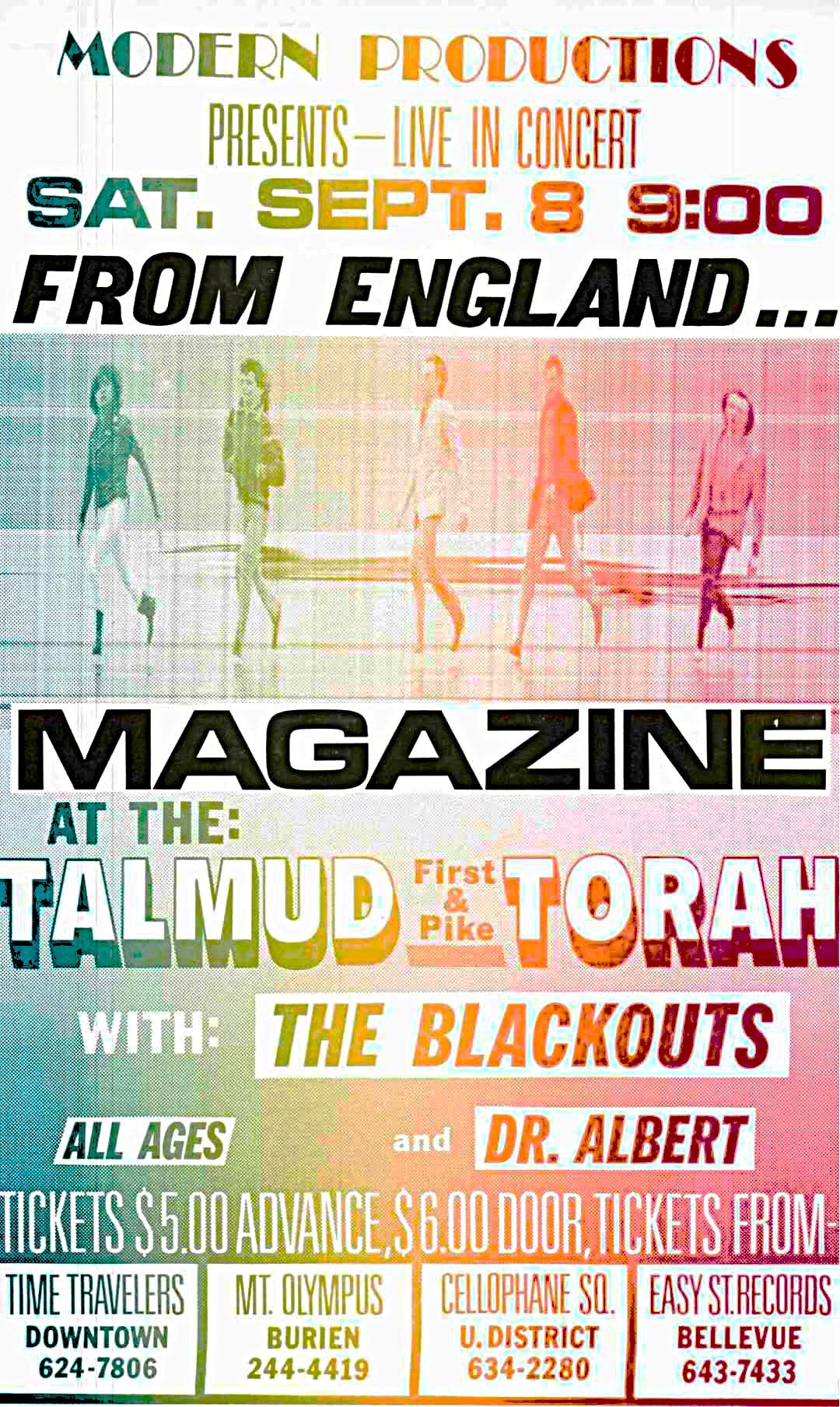
September 8, 1979, the first Modern Productions show ever at the Showbox, then still called the Talmud Torah.
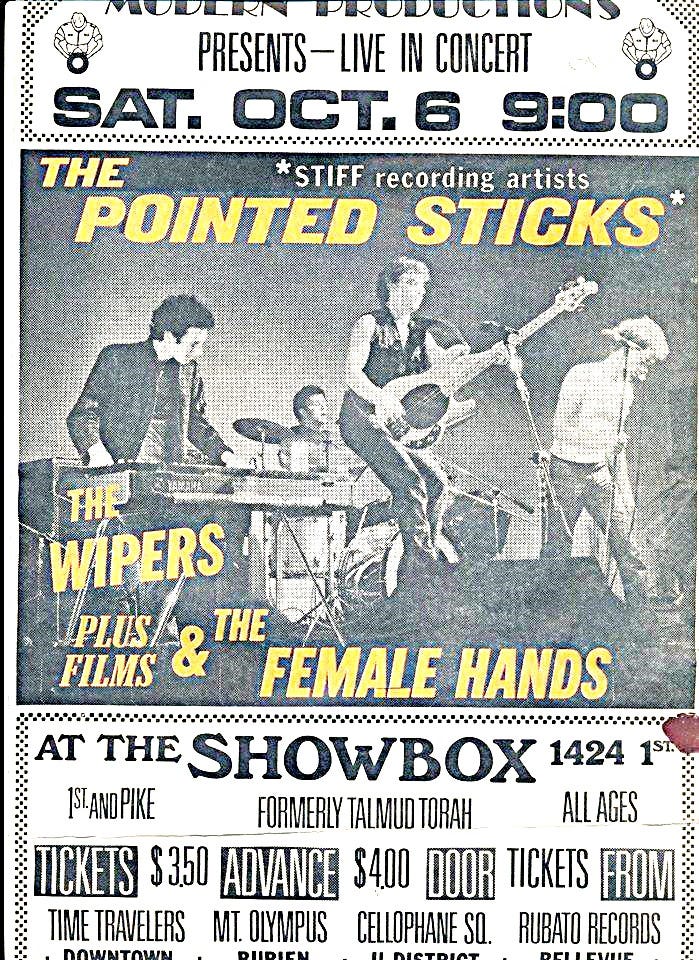
October 6, 1979 Pointed Sticks/Wipers show at the Showbox “Formerly Talmud Torah.”
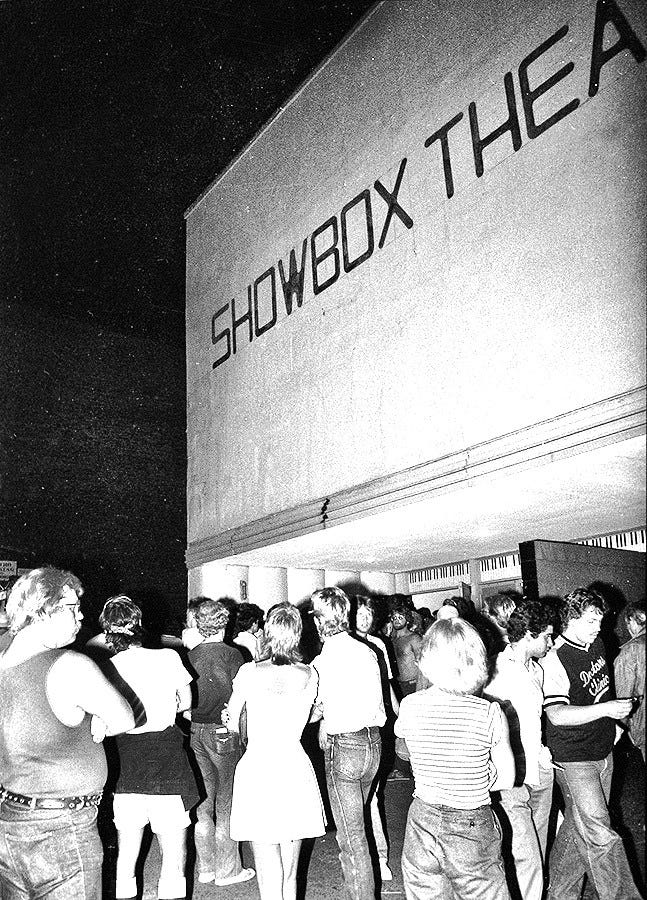


Top center photo of the Showbox in 1982. Photo by Marty Perez.
Bottom three documents of the February 12, 1983 TSOL show, the last punk/New Wave show at the Showbox until 1987.
The Showbox Theater’s Era of Decline
From March 1983 onward, the Showbox building sat closed and empty, gathering dust for most of the rest of the 1980s decade. In the Spring & Summer of 1984, I used to walk on foot all the way from my dad’s houses on top of Queen Anne Hill, down the steep 45 degree angle road known at the counter-balance, through Belltown, and all the way down 1st Avenue in downtown Seattle to the Pioneer Square area, where I would attend shows at the all ages punk clubs the Graven Image and the Grey Door. Along my route, I would always pass by the entrance alcove of the Showbox, its dusty wooden front doors padlocked shut, and just kept hoping that someday it would reopen.
One night when I was just happened to be standing right there at that spot in front of the closed entrance to the Showbox on 1st Avenue, a carload of frat boy jocks pulled up in front at the stop light with all their windows rolled down (it must have been summertime). They all took one look at me and one guy yelled out, “Hey! When’s Devo coming to town?!!!” The irony was that Devo had actually played there before, even though the venue had been closed for over a year by then. I wasn’t even a Devo fan, but I resented those guys making fun of me, apparently because of the way I looked, so I yelled back at them, “Not for a long time, assholes!” They didn’t reply at all and soon drove away in their car. They seemed surprised that I had dared to stand up to them, and I learned from that experience that even one guy with a punk attitude could defeat a whole group of frat boy jocks, who were usually loudmouths but pussies.
The other enlightening part of this experience was that it fit into this weird pattern in which other people who saw me kept branding me as being a punk rocker simply based on my appearance, even before I was fully conscious of self-identifying in this way. Was it the style of clothes I chose to wear? Was it my hairstyle? I didn’t even wear the standard cliché punk uniform of a black leather motorcycle jacket, Doc Marten’s black leather boots, and a mohawk haircut. I just dressed and looked the way I wanted to. Nonetheless, something about the way I looked just screamed “punk rock” to the other onlookers around me.
There were with only three known one-off events at the Showbox in the rest of the 1980s that temporarily re-opened its doors: one was an event for the On The Boards arts organization run by Mark Murphy that I’ve never been able to date precisely; another was a June 6, 1987 show by the U-Men, who were opening for Big Black, which was sponsored by the Center on Contemporary Art (COCA); and a third was a February 10, 1990 show by Mudhoney. I was at all three of them.
At the June 6, 1987 U-Men show, the first one at the Showbox in over four years since February 1983, Tom Price gave a long rant from the stage complaining that they were only getting paid $100 (I guess the headliners Big Black were getting most of the money), and reminisced about how he and the drummer Charlie used to break the heads off of parking meters to get the change because they were so desperate for money. Meanwhile, John Bigley silently winced and did not look amused. By this time, Jim Tillman had already quit the band and Tom Hazelmyer was on bass. I had the sense from this that they were just about over. The other weird thing about the show is that it was opened by some French mime troupe that kept chanting the obscene phrase, “cocks and cunts” over and over again.
At the February 10, 1990 Mudhoney show there was a long line of people waiting to get into the venue that had been closed for nearly three years since the last show there stretched down the sidewalk towards Union Street. Mark Arm walked up 1st Ave along the long line of people, with some hot chick on his arm, and looked amazed at how many people there were waiting to get in. Then, Mark Arm started the show by saying, “Who saw Devo here?” as a homage to its 1980 heyday. It was a much younger crowd by then, so nobody raised their hands. It was at that show that I ran into Tom Hansen (1961 – 2023), who pointed out to be that behind the stage there was a back-stage room where the original Fartz lineup used to practice. Most of the time they had practiced at this house in West Seattle known as “the gas chamber,” but I guess during the brief 8 or 9 months that he was in the band they had first practiced here. This was the last live music show at the venue until 1996.
The Showbox building had been built in 1939 and designed so that out in front of the series of side by side large wooden front doors at the entrance on the ground floor there was a large alcove or vestibule area that was covered by a roof but was open on the side facing the street. There was plenty of space for people to hang out here, and I think later it was fully enclosed as part of the ground floor lobby. The original marquee sign was gone but was replaced later after it was renovated. From the left side of the lobby you walked up a winding ramp that curved around and gradually brought you into the main music performance room on the second floor, which was notable for its fluted columns holding up the roof.
19) The Munro’s Dance Palace Show
On November 6, 1982 the Silly Killers opened for Canadian punk band the Dayglow Abortions at Munro's Dance Palace at 912 Elliott Avenue W., in the Interbay area in between Queen Anne Hill and Magnolia. It was kind of squirreled away on a small forested hilltop at the foot of Western Queen Anne Hill, where nobody would bother the people enjoying a punk rock show there. The other two local Seattle bands on the bill were the Boot Boys and Hobo Skank. From the gig poster it seems that the billing had Hobo Skank playing first, followed by the Boot Boys, and then the Silly Killers providing direct support to the headliners, the Dayglow Abortions. Tickets were only $3.00.
The Mike Leach Photographs
Fortunately, Mike Leach photographed this show. The photos can still be found on his websitehttps://www.bestrockphotos.com/Silly%20Killers/1982_3/index.html At this show, Slats oddly chose to dress in all white, wearing white pants and a white button up dress shirt with the collar turned up. Coincidentally, Eddie Huletz also chose to wear a pair of bright white pants. I’m not sure if they planned this matching color scheme. Eddie and Slats are both growing their hair out a little bit longer than before, while Slats is wearing a wool hat and sporting a pair of long sideburns. By this time Eddie does seem to have adopted some of the stage mannerism of Black Flag’s 4th singer Henry Rollins, including taking the microphone out of its stand and holding it upside down up in the air over his head while leaning his head back and singing into it. In one shot Carl Barish of the Boot Boys can be seen sporting his mohawk haircut and wearing a white dress shirt with the collar turned up, standing in the front frow of the audience with a big smile on his face while attentively watching Slats play guitar. Those two were always close buddies. The headshots of the audience reveal Big Jim was also watching them from the front row. Neither Gary Clukey nor Tim Gowell can be seen in the photos.
The Dayglow Abortions
The Dayglow Abortions were a Canadian punk rock band from Vancouver, B.C. who released their debut LP, “Out of the Womb,” in 1981. Later, 10 of the 14 songs were re-released as side B of their second LP, “Feed Us A Fetus,” in 1986. Coincidentally, I later booked the Dayglow Abortions to headline at the Central Tavern in 1986, and had Slats’ band Cheating Death open the show, making it the second time he had played with them. The band members all went by ridiculous monikers that disguised their real names. The key trio was Trevor Hagenk aka “Stupid,” on bass and vocals; Murray Acton, aka “Cretin” on guitar; and Brian Whitehead, aka “Jesus Bonehead” on drums. In 1986 they were briefly joined by second guitar player Chris Prohom, aka “Wayne Gretsky.”
As mentioned, the two other local Seattle bands on this November 1982 bill included the Boot Boys, and Hobo Skank. This was the second time that they had played with the Boot Boys. Slats and Carl Barish, the guitar player of the Boot Boys, were already close friends and would remain so for the rest of their lives.
Hobo Skank
However, it was the first time they had played with Hobo Skank, which featured Daniel “Chico” King on bass, and Big Jim Norris (1963-1988) on guitar and vocals. The drummer position rotated from originally being Gary “Wedge” Thompson, who was later replaced by Duff McKagan. Hobo Skank only released recordings of two songs, “Whorror Rock” and “Scammin’,” both being on the 1983 “What Syndrome?” cassette compilation. Big Jim Norris later ran the Grey Door all ages nightclub in 1983 and formed the band Crisis Party with Ward Nelson in late 1986. Big Jim Norris passed away on October 30, 1988 from a drug related death.
The Broken Nose Incident
Shortly after the Silly Killers had already played their set at this November 6, 1982 show, Slats and Big Jim got into a big fight over a girl, and Jim broke Slats’ nose. The same pool of girls, a lot of them so-called “Ave Rats,” would often rotate from one guy in the scene to another, Trish, Cathy, Fairhill, Jennifer, Laurie B., and Britta being among some of the main ones, most of them having bleach blonde or black dyed hair. For example, Big Jim Norris and Alex Maggot Brain lived with the same girl, sequentially, not at the same time. One girl went from Eddie to Don, another went from me to Eddie, one went from me to Ken D., and so on.
The Mentors
A couple years later, when I was managing On The Rocks, in 1984 Eddie Huletz and I, and our two bleach blonde girlfriends, went to another infamous show at Munro’s Dance Palace starring the Mentors, who had been the premier local punk rock band in 1978, when they headlined opening night at both the all ages club the Bird in March 1978, and the over 21 club Bugsy’s in May 1978, as well as the IOOF Oddfellows Hall in May 1978, but had moved down to L.A. since then and were now just visiting their hometown. Prior to the show El Duce tried to steal all my cans of beer I had brought with me, then he gave half of them back and we shared them. During the actual show the high point was when they played their big hit “The Four F Club,” with even all the girls in the audience chanting along to the lyrics out loud. It was an eye opening experience to say the least.
In recent years it’s become virtually impossible to post anything about the Mentors online in places such as the PNW Music Archives Facebook group without being shouted down and censored by an angry mob of ultra-left wing, politically correct critics, but the fact is that you can’t honestly deny the Mentors historical importance to the late 1970s and early 1980s Seattle music scene, whether you like their music and lyrics or not. To their credit, the Mentors believed in freedom of speech and stood up against the censorship of the PMRC.


Posters documenting five Mentors headlining shows in Seattle in 1978.
20) The Release of the Silly Killers Single
In December 1982, Kurt Bloch’s record label No Threes released the Silly Killers debut four-song 7” vinyl single. The songs had been recorded nine months earlier in March 1982, as already described above. In terms of packaging, on the front cover there was an odd photo of a fat man screaming, which was presumably some stock artwork they had found somewhere, while on the back cover there was a band photo taken by Emily Rieman, and inside there was a lyric sheet, on the back side of which was printed a crucifix-shaped band logo that looks a lot like the later one used by Guns N’ Roses five years later in 1987. There were several other outtakes from the Emily Rieman photo shoot that were not used but might have been better, including one of the band standing in front of a police car on the Ave.
21) The Search for a New Drummer
On March 1, 1983, Gary Clukey placed a classified ad in Seattle’s monthly music magazine The Rocket, openly stating that the Silly Killers were looking for a new drummer. This indicates that their original drummer Tim Gowell, who played on their 1982 single, had quit the band by March 1, 1983. The ad said that candidates must be willing to “do originals, travel, practice, play fast and loud.” Considering these four stated requirements, it seems plausible that Tim Gowell may have left band because he was unable or unwilling to do one of them. Based on subsequent events, it seems that possibly the main reason was that he may have been unwilling to travel out of town. In the meantime, it seems that Duff McKagan filled in on drums, including on a trip they took down to S.F. less than two weeks later.
22) The March 1983 Trip to San Francisco.
On Saturday March 12, 1983, the Silly Killers played at the Sound of Music club located at 162 Turk Street in the Tenderloin District of San Francisco, CA. There is a club ad for this show in the Friday March 11, 1983 issue of the San Francisco Examiner newspaper. Unfortunately, they were the opening band on a four-band bill with Plastic Medium, Men In Black, and the headliner VKTMS.
This is the one and only Silly Killers show in San Francisco that it’s been possible to document, and which proves that they were down there at this time. However, I do recall getting the impression from other archival oral comments back in the day that they had stayed down in S.F. longer, maybe for a couple of weeks, and had tried to relocate there, without success. So, it’s possible that while down there they may have picked up some more gigs that have not been documented.
Based partly on the March 1, 1983 classified ad in The Rocket, I believe that their original drummer Tim Gowell had quit by this time and Duff McKagan was temporarily on drums. Duff has said before that he went down to S.F. with the Silly Killers, without providing any date for it. He’s also said that he played with one Seattle band in S.F. and then went up to Portland, Or to play a show with another Seattle band there, which could have been the show where Ten Minute Warning opened for the DKs at La Bamba’s on April 26, 1983, but that’s a pretty big gap of 12 days after the only show the Silly Killers are definitely known to have played in S.F.
23) Music Critics Reviews of the Silly Killers’ Single
The Silly Killers single’s first record review, and the only contemporary review outside of Seattle, seems to have been the one published in the January/February 1983 Issue #4 of Maximum Rock N’ Roll, a magazine based in San Francisco. https://www.maximumrocknroll.com/review/mrr-4/not-that-time-again/
The MRR reviewer Jeff Bale wrote the following:
“Musically, this is a neat garagey record with both punk and rock overtones. In the midst of all the new political thrash bands, the SILLY KILLERS actually sound somewhat refreshing, even though they employ older stylistic devices. But the lyrics—yecchh!”
On April 1, 1983 Seattle monthly music magazine The Rocket finally got around to printing a review of the Silly Killers debut four-song, 7” vinyl single, which had actually been released by Kurt Bloch’s label No Threes Records four months earlier back in December 1982. By this time their original drummer Tim Gowell was no longer in the band, and the lead singer Eddie Huletz was about to quit by the next month, with Silly Killers II reformed with bass player Gary Clukey switching from bass to lead vocals and Todd Fleischman joining on bass.
Nonetheless, despite being a bit late to the party, the review, oddly written by Scott McCaughey of the Young Fresh Fellows, was favorable, calling the single a “rockin’ disc,” and “ A raw slice of Seattle life.” The record was recommended for anyone who’s “ever been bothered by an alarm clock, a preppie wavette, or the Broadway nightlife scene…” The reviewer complimented the “great guitar work,” and “songs that any Emerald City boy can related to.” The band was described as a “no-holds-barred,” “heavy-handed but speedy quartet.”
In the same month as the Rocket review, the Silly Killers single also received a record review written by Joe Smitty (aka Jeff Smith), the singer of Mr. Epp in the April 1983 Issue ##8 of Seattle’s Attack fanzine. https://www.dementlieu.com/users/obik/arc/mrepp/attack8.html
These are the only three known contemporary reviews it received.
24) Music Critics Reviews of the Silly Killers’ Compilation Tracks
April 1, 1983 Seattle monthly music magazine The Rocket reviewed a cassette-tape compilation of local bands called “The What Syndrome,” on which the Silly Killers had several songs, “Nothing To Say,” and “Big Machine.” Duff McKagan is credited as having played drums on both tracks, as continuing evidence that he had temporarily become the band’s drummer as Tim Gowell’s replacement around March 1, 1983. However, Eddie Huletz was still credited as the band’s lead singer, indicating that Silly Killers II had not reformed the band yet.
25) Eddie Huletz Leaves the Silly Killers: April 1983
On Friday, April 29, 1983, a new band called the Miserables played their first known show at Washington Hall, an all ages rented hall at the intersection of 14th and Fir near Yesler Terrace, opening for a four-band local bill featuring the Boot Boys, Cannibal, and YBGB. There is a surviving gig poster for the show. Eddie Huletz was the singer for this new band, so it indicates that he was out of the Silly Killers by this point. Probably Eddie had been upset by the poor results the band got from their trip down to S.F. Other members of the Miserables included Tom Hansen (1961 – 2023) of the Fartz and Refuzors on guitar, and Tom “Bonehead” Simpson on bass. About a year later, in the Spring of 1984, the Miserables changed their name to On The Rocks and I started managing them.
In contrast to the hardcore punk rock sound of the members previous bands, the Silly Killers, Fartz, and Refuzors, the Miserables/On The Rocks represented a major shift towards a slower, bluesier sound with prominent guitar solos that was more influenced by the New York Dolls and Johnny Thunders’ Heartbreakers, albeit a slower sound that was still punctuated by and alternated with periodic bursts of rapid fire downstroke guitars, which made their sound a unique hybrid mixture of hardcore and blues. This musical difference could have been another motivation for Eddie quitting the Silly Killers.
26) The May 1983 Kid Dome Show: The Debut of Silly Killers II
On Saturday, May 21, 1983 the Silly Killers played the legendary “Kid Dome” show at the historic Fox Island School House, which was built in 1934 and has been on the National Register of Historic Places since 1987, way down southwest on the Kitsap Peninsula in Gig Harbor. The Fastbacks were billed as the headliners, with the Blaine Cooke version of 10 Minute Warning opening and the Silly Killers playing second.
At the time this show was organized, the Showbox had been closed for several months since the end of 1982, the Metropolis had barely opened eight days earlier with their first show on May 13, 1983; and unless you were the local opening act, Eagles Auditorium was such a large venue that it would only book out of town international and national touring acts, so there were was nowhere in their own hometown for a local Seattle punk rock band to play.
This show was significant for marking the debut of Silly Killers II, and helps us date the departure from the band of original singer Eddie Huletz, who also know was singing for the Miserables by April 29, 1983. By this time original bass player Gary Clukey had switched to being the lead singer, and Todd Fleischman had joined on bass. Most surprisingly, the photographic evidence shows that the Silly Killers original drummer Tim Gowell had now rejoined the band, after having been absent from the band’s March 1983 trip down to San Francisco, as well as the recordings made for the “What Syndrome?” compilation and the now rediscovered basement tape. Since Eddie had quit the band, Duff would not have wanted to continue with them without him since they were best friends.
There was a group photo taken of most the participants standing under a sign that said “Kid Dome,” although that name did not appear on the flyer, so it’s gone in legend as the Kid Dome show. People who can be seen in the group photo include members of the Fastbacks, the Living, Ten Minute Warning, and the Silly Killers. Since Blaine was fired from 10MW in May 1983, the show would have had to be before or by then. Also, Eddie Huletz does not appear in the group photo, but other members of the Silly Killers do, including Slats and Garey Clukey. Todd Fleischman is in the photo standing with other members of the Living, including Duff McKagan and Greg Gilmore, but the presence of Blaine Cook, and the absence of Eddie Huletz, makes me think Todd must have been in Silly Killers II by the time of this photo. Slats can be seen wearing a U.K. Subs T-shirt.
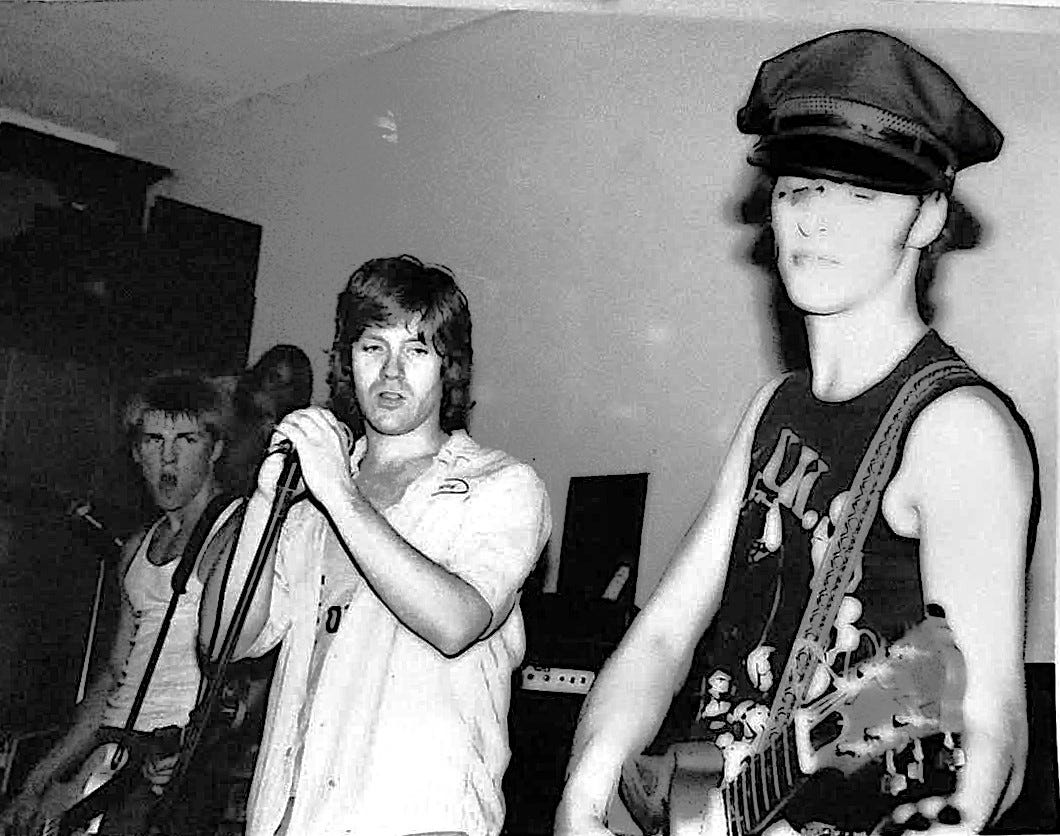
Silly Killers II circa May 1983. Photo courtesy of Todd Fleischman.
27) The September 1983 Personality Crisis Show at the Metropolis
On Tuesday, September 6, 1983, the Silly Killers opened for the Canadian punk rock band Personality Crisis at the all ages Metropolis venue down in Pioneer Square.
The surviving gig flyer billed this show as “The Return of the Silly Killers,” and featured four individual photos of the band members in the then current lineup that made it very clear that this was what we call “Silly Killers II,” i.e. it’s the lineup without Eddie Huletz after Eddie quit. The band photos on the poster clearly show that original bass player Gary Clukey was now the lead singer, while Todd Fleischman of The Living has joined on bass, Slats was still playing guitar, and original drummer Tim Gowell seems to have returned on drums again after a brief hiatus in March 1983 when he had been replaced by Duff McKagan. This surviving flyer is an important historical document because it tells us that by this date of Sept. 6, 1983 Eddie had quit the band and the lineup had been significantly shaken up. Actually, the changeover may have well happened earlier. Evidence suggest that the May 1983 Kid Dome show was the debut of Silly Killers II.
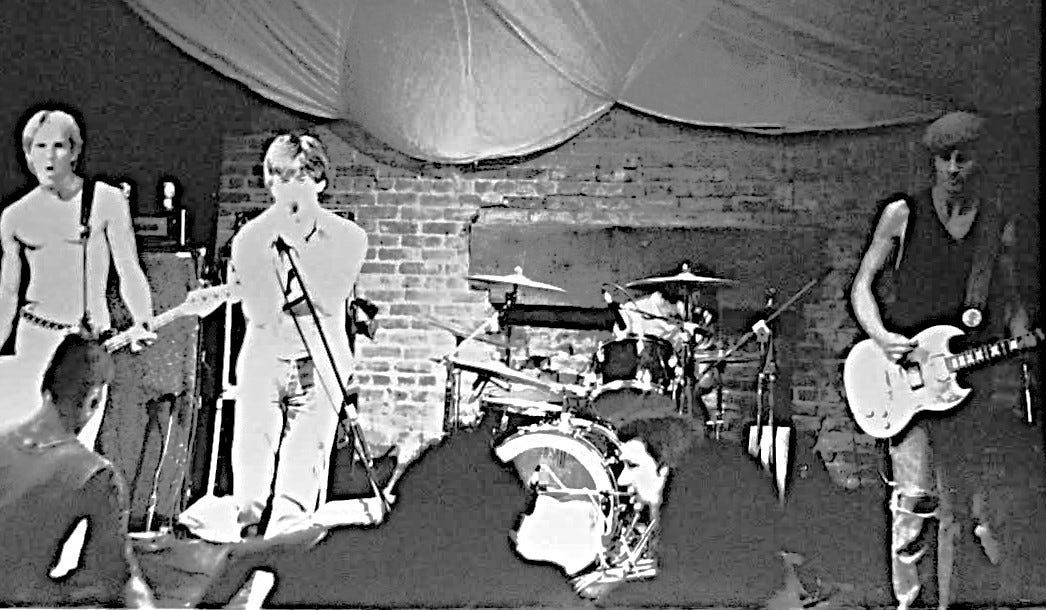
Silly Killers II at the Metropolis in 1983. Photo courtesy of Todd Fleischman.
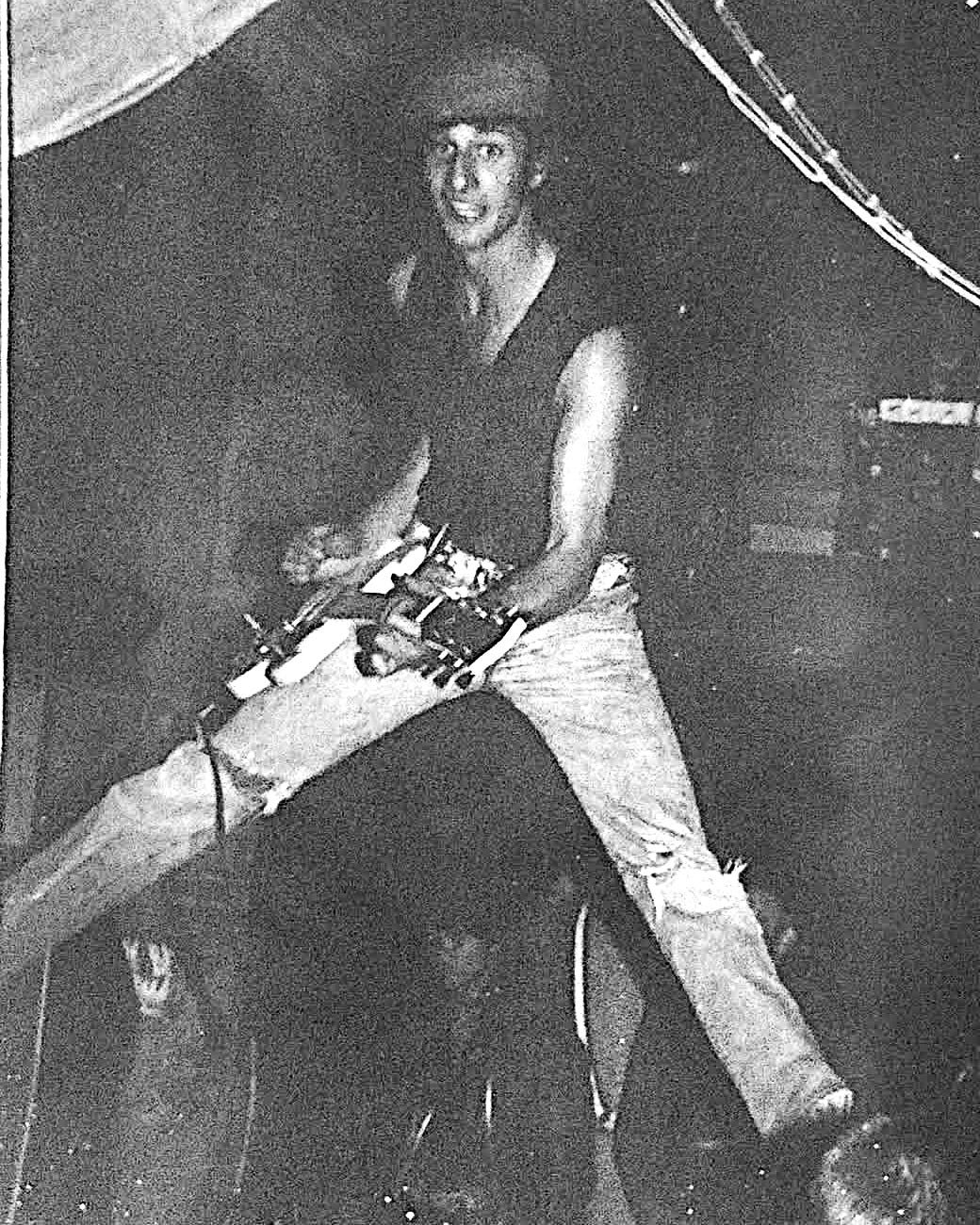
Slats at the Metropolis in 1983. Photo courtesy of Todd Fleischman.
Personality Crisis
Personality Crisis was a Canadian punk rock band from Winnipeg, Manitoba, unlike most Canadian punk bands that tended to be from Vancouver, B.C. Although formed in 1979, they reached a peak in 1983 with the release by the Risky Records label in San Francisco of their 12-track debut album, “Creatures For Awhile,” which was also the only recording they put out during the band’s original lifetime, before they suddenly broke up in 1984. In 1984 they also had one non-LP track appear on compilation album “Something to Believe In” released by the Better Youth Organization (BYO) run by the L.A. punk band Youth Brigade. On April 24, 1984 Personality Crisis played Seattle one last time at the all ages Grey Door club with R Gang as the local opening act.
Six years after the band broke up, in 1990 they released two songs on a 7” single that was only available in the U.K. The A-side “Twilight’s Last Gleaming” was a studio track from the 1983 album, but the B-side, “The Jam,” ironically was a live track that had been recorded at this same September 6, 1983 show at the Metropolis in Seattle. In the same year the same U.K. label, Overground Records, re-released the whole 1983 album, but only in the U.K. The album was re-released again in Canada in 2009, and in the U.S. in 2021 and 2023. Despite having been released on vinyl five times, the 1983 “Creatures for Awhile” album has never been available on CD.
Despite being a punk band, Personality Crisis in some ways defied the standard hardcore musical genre of their day. First of all, they were named after a song by the New York Dolls, who were not then considered nearly as cool as they are today. Secondly, they were a five-piece band that had a double guitar attack in the form of the two guitar players, Jimmy Green and Richard Duguay, one of whom tried to join the Seattle band On The Rocks in 1984 after Personality Crisis broke up.
After the band broke up, their drummer Jon Card later played on two albums by SNFU in 1986 and 1991, joined D.O.A., playing on three of their studio albums between 1987 & 1990, and live album recorded in 1990 but released in 1991, and played on a Canadian Subhumans reunion album in 2006.
Meanwhile, guitarist Richard Duguay played lead guitar on one song, “You Can’t Put Your Arms Around a Memory,” with Eddie Huletz of On The Rocks singing back up vocals, on the 1993 Guns N’ Roses album “The Spaghetti Incident,” played lead guitar on two singles by the Pagans released in 2016, and released four of his own solo albums under his own name between 2011 & 2022.
The Metropolis
The Metropolis was an all ages live music venue located at 207 2nd Avenue South, near its intersection with South Washington Street, about two blocks West of Occidental Square, that was run by Hugo Piottin, a Frenchman who had saved up some money from working as a commercial fisherman up in Alaska Although they managed to book a lot of out of town touring acts, particularly punk & indie bands from California, Oregon, Canada, and Minnesota, it was open for less than a year from May 1983 through March 1984 with the last show being on March 6, 1984. Although not located directly on the corner, there was a large parking lot between the club and South Washington Street, so that you could easily see the building from that East-West street. On the night of a big show at the Metropolis, such as the Wipers, that parking lot on the corner was often full of young punk rockers in black leather motorcycle jackets drinking Old English 40 ouncers of brown paper bags, and it was that outdoor activity that probably caused the neighborhood complaints that eventually got the club shut down. From Washington Street you turned right and headed South down 2nd Avenue, where you found the actual entrance to the club. The club was located in this one-story brick building that had no second floor. As I recall, it was built like a brick fortress with no back door or windows, so there was no way for people to sneak in without paying the cover charge at the front door, unlike a lot of other all ages venues in Seattle in the 1980s that suffered from this problem.
Hugo himself would usually be standing at the door to collect the money. From the front entrance you could not go directly into the main music room, which I think was by design in order to prevent a bum rush by people trying to get in, and also to prevent the sound of the music from drifting outside. Instead, once you had paid the cover charge at the front door you had to make a sharp turn right and walk down this long hallway headed North. As you were going around that first corner, you would pass Hugo’s office on your right, which was a room where he kept his account books that had a written record of every show with the date, the names of the bands that had played, the total gross door money that had come in, and exactly how much money each band had been paid. One time the manager of a Bellingham-based synth band called Applied Science told me that they had once played the Metropolis but not gotten paid. Somehow I had the nerve to later actually mention this to Hugo, who immediately opened up his accounts book, turned to exactly the right page in it, and showed me exactly how much the total door money had been that night and how much Applied Science had been paid. If those account books still existed they’d be an invaluable source for documenting the history of the club.
Anyway, once you had turned right, passed Hugo’s office, and walked down the long hallway headed North, at the North end of the building you would turn left into this fairly large room furnished with table and chairs that had a bar, but the bar didn’t serve any alcohol, instead it was kind of a juice bar that sold non-alcoholic drinks. Turning left again and walking through this room would then take you to the main music room, which was a standing room only space with no furniture and a large stage.
Behind the stage was a brick wall covered up with a white parachute. So, whenever you see a photo of band playing live on stage with a white parachute behind them, that’s a clue that the show was probably at the Metropolis.
Some of the biggest shows by touring bands that occurred there probably included the Wipers, (2x) Husker Du, and the Replacements. The local acts that played there the most included the Fastbacks and the U-Men.
The Husker Du show was originally supposed to be headlined by the Circle Jerks, who were on the poster but simply didn’t show up, even though they’d been paid cash in advance. It’s a good example of how a lot of the out of the out of town bands, particularly those from L.A. sort of held Seattle in contempt at the time as an uncool place populated by poor peasants who weren’t really deserving of their attention.
Bands like the Circle Jerks, MIA, TSOL and sometimes even the Wipers would say they were coming, and then just not show up, sometimes calling at the last minute and claiming “van trouble” as an excuse why they couldn’t make it, when really they just didn’t want to come.
Or, they would demand that the promoter pay them a contractual guarantee of an exorbitant amount of money that was far beyond what the local music scene’s ecosystem could actually support, the Wipers once demanding $2,000 from me, the Circle Jerks demanding $600 in advance and then not showing up after they got it, and the Descendants demanding a guarantee of $600 and then even after they got that threatening to beat me up if they didn’t get some more.
The former Metropolis building is still there today. For a while it was an Asian teriyaki & ramen restaurant called the Izumi Cafe, but lately its been vacant and for rent. Photos of the building’s front exterior posted on various real estate websites such as Redfin, Loop Net, and the Corcoran Group show it looking remarkably the same as it did in 1983, which is pretty shocking considering all the other changes that have happened to Seattle since then.
When Zach Turner asked me to describe the Metropolis club during an on camera interview in the Summer of 2023 I had a panic attack and froze on camera, so now I’ve set the record straight.


Photographs of the Metropolis in 2024.
28) The Silly Killers Last Show: October 1983
On Thursday, October 6, 1983, Silly Killers II played a second show at the Metropolis all ages club in Seattle on a five-band bill with Moral Crux, Ten Minute Warning, the Fastbacks, and Shanghai Dog as part of the “Street Kids Benefit.”
The headliners Shanghai Dog were a Canadian punk rock band from Vancouver, B.C. that featured Mike “Normal” Graham of the Subhumans on guitar. They had a four-song E.P. called “Clanging Bell” that was released in 1983. I later booked them for three shows in 1984 and 1985, when Eddie Huletz’s post-Silly Killers band On The Rocks opened for them three times.
29) The 1983 Silly Killers Film Footage
At least one of the several Silly Killers II shows at the Metropolis was filmed and that footage can now be seen on YouTube. However, it’s not clear exactly which of the two shows that footage is from. The lineup at this stage was former bass player Gary Clukey on vocals, Slats on guitar, Todd Fleischman of the Living on bass, and seemingly original drummer Tim Gowell back on drums again. In this footage, this last lineup of the band doesn’t really seem to be gelling. Fleischman plays his heart out and visually totally dominates the stage, but the whole band is not really in sync properly, and Clukey is barely able to sing at all. It's a shame that there’s no film footage of the original Silly Killers lineup.
Carlene Heitman also photographed at one of these two shows. Her photographs reveal that Slats wore no head gear on stage, no bandana and no hat, for once revealing his curly, red locks of hair.


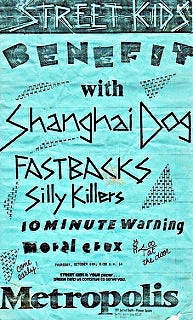


Above is a gallery of archival Silly Killers photos and posters. Except for the Kid Dome photo, all Silly Killers photos in the above gallery from 1982 and taken by Emily Rieman. Kid Dome photo from 1983 by unknown photographer.


Above is a gallery of Silly Killers press clippings from various newspapers in Seattle, San Francisco, and Vancouver, B.C.
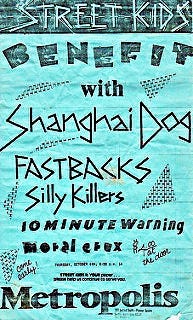
III. Itchy Brother
Slats’ first post-Silly Killers band was called Itchy Brother. They were booked to play five known shows a venue called the Gorilla Gardens during the first half of 1985 before breaking up. Itchy Brother featured Slats on guitar, with Alex Sibbald on bass and Steve Porehad on vocals. Their original drummer was Gary “Wedge” Thompson, but he was later replaced by Dain Hudson.
In 1980-1981 Alex Sibbald and Steve Porehad had both previously been in a band called the Maggot Brains who were notable for being a three-piece that had no guitar player at all. They played shows at the Gorilla Room, Danceland U.S.A., and the Showbox Theater. In the summer of 1981 they recorded a five song demo tape produced by Harry Kool that in 1982 had a limited cassette tape only release with Lloyd Shattuck’s (aka Loud Fart) first band KAOS on the other side. Alex Sibbald was sort of the Lemmy of Seattle and had taken playing bass to such a high art form that it was often said he was too good to play in regular band with a guitar player. When the Fartz changed their name to 10 Minute Warning in November 1982, and Steve Hoffman (1957-2017) quit soon thereafter, Alex Sibbald auditioned to be his replacement on bass, but was considered to be too good for the job, and so they chose David Garrigues instead. After he joined Itchy Brother, and later Cheating Death, Slats used to always say, “At least he can play in a band now,” meaning that he had sort of toned down his bass leads enough to fit in with a guitar player.
1. Sunday, January 13, 1985 Slats’ Itchy Brother played their first known show at the Gorilla Gardens with Bam Bam & the Refuzors. The Gorilla Gardens was a large all ages live music venue in Chinatown that had been a movie theater and was opened by Tony Y. Chu (Chew) in December 1984. In 1980-1981 Chu had previously been the proprietor of the much smaller and over 21 .
2. On Friday March 8, 1985 Itchy Brother played a second show at the Gorilla Gardens with Cannibal. Cannibal featured Lloyd Shattuck (aka Loud Fart), the former drummer of the Fartz, on guitar and Rick Dorgan of the Boot Boys on drums, as well as Al Mock on bass and John Daily on vocals. Loud is most famous for being the drummer in the Fartz in 1980-1982, but actually he had been a guitar player before that in his first band KAOS, and quit the Fartz out of the frustration of wanting to go back to playing guitar again.
3. On Friday May 10, 1985 Itchy Brother played the Gorilla Gardens for a third time opening for the Fastbacks, No Means No, and D.O.A.. Previously, the Silly Killers had been booked to play with the Fastbacks five times, and had gone all the way up to Canada to play that one show with D.0.A. at Arcadia Hall in December 1981. No Means No were also from Canada.
4. On Thursday, June 13, 1985 Itchy Brother played the Gorilla Gardens for a fourth time with the Rejectors.
5. On Saturday June 29, 1985, Itchy Brother played at the Gorilla Gardens again for a fifth and final known time, opening for the Vandals, a first wave punk band from L.A, and the Rhythm Pigs from Texas, on a large seven-band bill with R.P.A., the Queen Annes, Cannibal, and believe it or not, an early Soundgarden.
It was probably after this that Itchy Brother broke up, and I attempted to schedule the ill-fated and aborted Silly Killers reunion show at the Gorilla Gardens, which Tony Godbehere (1953-2021) wanted to promote, but which didn’t happen because Slats and Eddie had some disagreements about it. Eddie said he would need time to re-learn the songs again, Slats got upset and decided to do it without Eddie, presumably as Silly Killers II, but Tony canceled the show saying “It’s not the Silly Killers without Eddie.”
Speaking of which, Eddie Huletz’s band On The Rocks was also booked to play the Gorilla Gardens four times in the first half of 1985, but that’s a separate long story in itself.
The Gorilla Gardens
The Gorilla Gardens was an all ages live music venue in Chinatown that was a former movie theater that had been rented out by Tony Y. Chu (sometimes spelled Chew), a Chinese businessman had formerly run the over 21 Gorilla Room in 1980-1981. The venue was quite large, with at least a 400 person capacity in the main room, and the design of the place was similar to that of the Showbox Theater.
Outside the front door was a small alcove area where a couple of cars could park, which was useful for a band loading their gear in our out. Inside the front door was a large lobby area where people would tend to hang out and socialize before going into one of the two performance rooms to see a show. Few if any rules were enforced. The doorman never patted you down or checked your pockets for any contraband, so you could BYO beer, booze, cigarettes, and even narcotics, and nobody would care. So, Eddie Huletz and I would stand around in the lobby drinking and smoking, hanging out with our girlfriends by our side.
One night El Duce of the Mentors walked by us in the lobby and pinched my girlfriend in the ass, after which he walked while looking back at us and laughing hysterically. At the very first show in December 1984 I met Gibby Hayes, the singer for the Butthole Surfers, in the men’s room while he was putting clothes pins in his long, tangled hair.
Anyway, from the right side of the lobby you headed up a long curving, diagonal ramp, kind of like at the Showbox only on the other side. The ramp first passed the entrance to the smaller room on the right, and then at the end headed into the second level of the main room. The main room had two levels. All the seats had been torn out of the bottom level to turn it into a kind moshing, slam dancing, stage diving, standing room only pit right in front of the large stage. But the upper level still had rows of cushioned seats rising up at an angle. I liked to stand on this front ledge of the second level, which gave me an unobstructed view looking down on the stage below.
Although the place was owned by Tony Y. Chu (surname sometimes spelled Chew), he needed the help of someone else to actually chose which bands should play and book the acts. In the beginning, the club was mainly managed by the team of Doug Mays and Ed Shepard. In fact, in a photo published in the January 1985 issue of the Rocket announcing the venue’s opening, Doug and Ed were shown on the Gorilla Room’s stage together. Doug had been the band manager of X-15/Life in General back in the Gorilla Room days, so and Chu already knew each other. Shepard had been a local concert promoter since the May 1978 IOOF Oddfellows Hall show starring the Mentors and the Lewd, and was closely connected to the Moberlys, but was developing an increasingly dubious track record. The club’s soft opening on December 7, 1984 with the Butthole Surfers; the massive New Year’s Eve show on December 31, 1984 headlined by the Young Fresh Fellows and featuring almost every local band in town (except for the U-Men & PopDefect at the Meatlockers and On The Rocks & the Queen Annes at the UCT Hall, two competing but smaller shows that same night); and the first couple of months went well. A lot of the big shows in January and February 1985 were already being booked by independent promoter Tony Godbehere (1953-2021), who had previously been a member of the band DSML and Maire Masco’s promotion organization the Holy War Cadets, such as the Wipers, Sonic Youth, TSOL, and Husker Du.
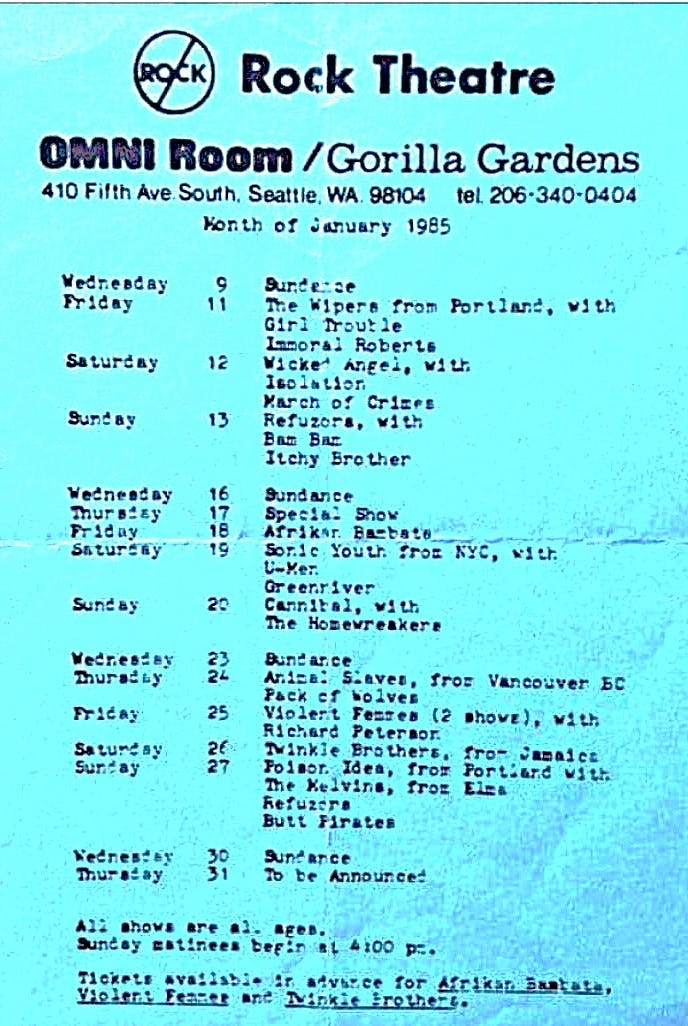


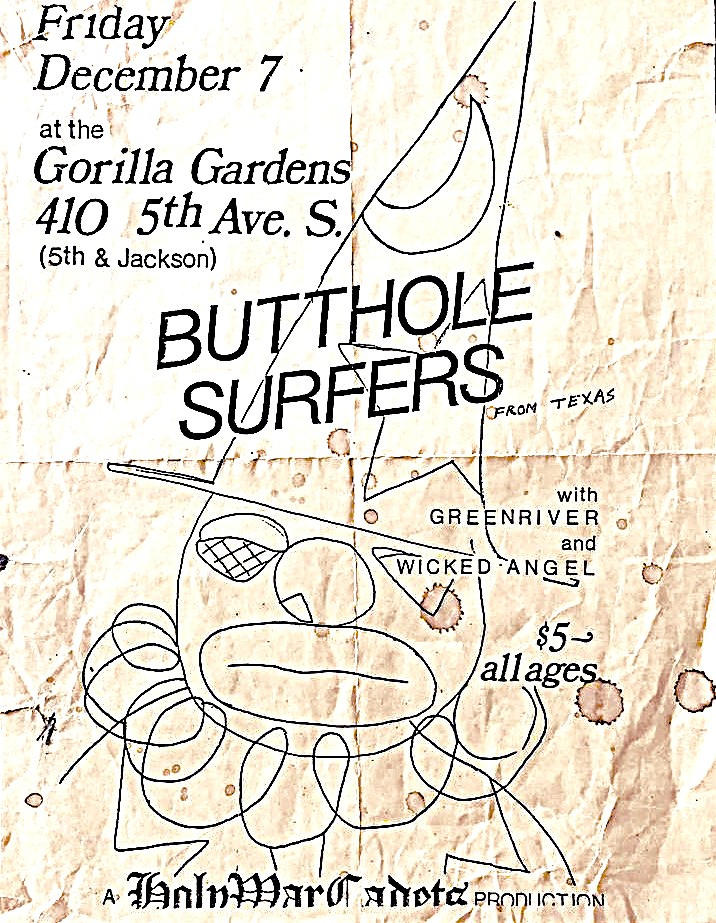
The first show ever at the Gorilla Gardens on December 7, 1984.


Husker Du poster marks the last ever show at the Gorilla Gardens original location on October 26, 1985. Bottom two photos of the former Gorilla Gardens, now a Carpet King warehouse, taken in the 21st Century.
After the venue’s initial success, things turned sour with Ed Shepard’s Afrika Bambaataa show on Friday January 18, 1985, which turned into a huge riot of people demanding their money back, because they had expected Bambaataa would come out with a troupe of dancers backing him, but instead he just stood there all alone with a turntable scratchin’ records. What made it worse is that Ed didn’t even bother go to his own show. He just booked it and trusted Doug to run it for him. While the riot in Chinatown was going on, Ed was actually having drinks with me at the Hall of Fame bar on the Ave in the U-District, a public pay phone conveniently installed next to our table for business calls, waiting for Doug to show up with his share of the money.
Needless to say, Doug never showed up at the Hall of Fame, and Ed Shepard was never allowed to do another show at the Gorilla Gardens. Instead he had to do his next all ages show starring John Cale of the Velvet Underground on February 13, 1985 at Le Club Hit on Westlake Ave, but Cale was a no-show, and Ed disappeared without giving any refunds to disgruntled ticket holders who had showed up only to see the opening act the Fastbacks play their hearts out, followed by no headliner. Coincidentally, at about the same time Doug Mays accepted an offer he couldn’t refuse to become the road manager for a touring reggae band called Alpha Blondie. Thus, the initial team of Mays and Shepard moved out of the way for Tony Godbehere (1953-2021) to basically take over and promote the majority of the shows held at the Gorilla Gardens for the rest of the year.
The venue’s last show at its original location was Husker Du on Saturday October 26, 1985, before it briefly tried to move to a new location at 307 Nickerson St., at the North foot of Queen Anne Hill, where the infamous Circle Jerks riot later took place. The original location was most recently a carpet warehouse used by Carpet King for storing long rolls of carpeting.


IV. Cheating Death
Slats’ fourth band was called Cheating Death. Sometimes spelled Cheatin’ Death with no g. It was active for less than a year in 1986. Cheating Death, featured Slats on guitar, former Maggot Brains and future Accused member Alex Sibbald on bass, and Carl Boot Boy’s younger brother Paul Barish on vocals. Gary “Wedge” Thompson of the Refuzors and On The Rocks was on drums. They had a theme song called “Cheating Death” with a lyric that went like, “We should be dead, but we’re still here. We’re cheating death! Yeah!” Except for some rehearsal tapes, and a videotape of one complete show at the Central Tavern, both of which are still in the possession of the former drummer Gary “Wedge” Thompson, they never recorded anything in the studio. I was their band manager. As such, I booked and promoted most of their shows, and arranged for the videotape filming of that one show. The band actually seemed to be going somewhere and was picking up steam with more club bookings, and more people coming to see the shows, until Alex Sibbald suddenly quit the band at the end of 1986 to join the Accused
1. On Friday May 16, 1986, Cheating Death headlined at the over 21 Golden Crown with Gut Reaction as the opening act. This was Cheating Death’s first known show.
Gut Reaction was sort of a Bopo Boys band with Jon Driver on guitar, Todd Nelson on vocals, Daniel “Chico” King on bass, and “Little” Richard D. Williams on drums,. Jon Driver and “Little” Richard had previously been in the band called the Bopo Boys (not to be confused with the JAKS-affiliated skateboard team/youth gang of the same name, which included some, but not all of the same people). Richard D. Williams was notable not only for being a very professional drummer but also for being one of the very few Black people involved in the Seattle punk rock scene at the time, except for Damon Gayden and some of the other Fallen Angels, who had all gone to Garfield High School. Daniel “Chico” King had been in the bands Hobo Skank and YBGB.
Todd Nelson had previously been in this sort of Goth synth duo known as Souls in Darkness, who opened for 45 Grave at the Meatlockers on Saturday, October 27, 1985; and later, after Gut Reaction broke up, went on to be the singer for Hippie Big Buckle, which featured Dan Blossom of Feast on guitar. Despite their name, Hippie Big Buckle were very reminiscent of the Birthday Party, and Todd was able to fully display all his Nick Cave tendencies, making guttural sounds and animalistic grunts come out of his mouth instead of any intelligible lyrics, while sometimes dressed in a hairy gorilla costume. Todd sadly died of a drug overdose in the 1990s.
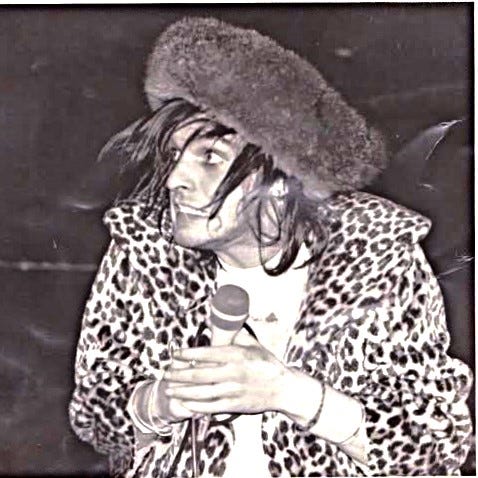
Todd Nelson, formerly of Souls in Darkness and Gut Reaction, in this photo singing for Hippie Big Buckle. Photographer unknown.
The Golden Crown was a pretty easy venue to get booked at because it was on the top floor of a building that could only be reached by climbing up a seemingly endless vertical stairway to heaven, with there not even being a freight elevator to load the gear in or out, resulting in nobody really wanting to play there. Plus, the building was about to be torn down to make way for the Westlake Mall Shopping Center, so the club owners didn’t want to invest any money in making any repairs or improvements to it.
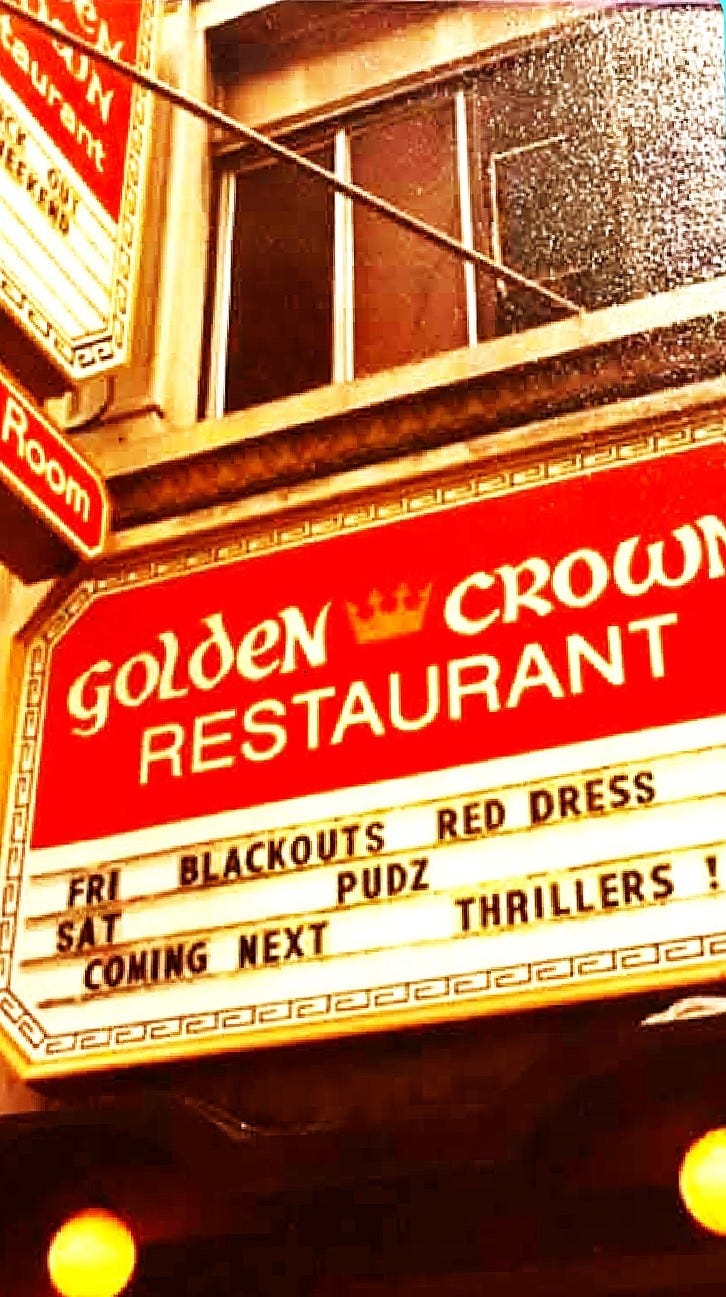
Front facade of the Golden Crown. Photographer unknown.
2. On Friday May 31, 1986, Cheating Death headlined their second show at the over 21 Golden Crown, this time with the two local bands Know Tomorrow, and oddly enough, Debutante.
Know Tomorrow was a brief band fronted by Scott Dittman, who had previously also been the singer for the Cheaters, and the Zipdads. The band’s lineup changed over time, but at various times it included Todd Fleischman of the Living and Silly Killers II on bass, as well as sometimes Carl Barish of the Boot Boys on guitar. I don’t recall who the drummer was.
3. On August 28, 1986 Cheating Death played their third show ever at the Ditto Tavern on 5th Avenue with Debutante. At this time the small venue was being booked by Dean Wartti of the Center for Disease Control Boys, which also featured Chris Cornell of Soundgarden. Cheating Death didn’t appear in the club listing for this show printed in the Rocket magazine, because the Rocket was a monthly publication with a deadline for submitting press releases that could be over as early as over a month before the show. As we’ll see from the lengthy, long-winded description below the original act that was booked and appeared in the club listing, Debutante, were later joined by Cheating Death who were added to the bill about a week before the show happened. Both bands ended up playing, and ironically, I had been managing and booked both bands. Another band who appeared in the club listing for this date, Eve’s White Horsemen starring Otis P. Otis and Sam Henry of Napalm Beach, did not actually play that night after all.
Debutante
And now allow me to indulge in a little side-track that helps set the stage for Cheating Death’s August 28, 1986 Ditto show.
In the first half of 1986 I had been managing this long-haired, East Side, heavy metal/glam rock band called Debutante, who hung out with Doug Blake, the ex-bass player for Overlord, and James Tolin, their former manager. Overlord had released a five-song E.P. in 1982 called “Broken Toys,” but they broke up in 1983, I believe. By 1986 I had decided that punk rock was over and it was time for me as a band manager to move on and try to do something with a bit more commercial appeal. Debutante had recorded a pretty good sounding demo tape with this one potential hit song called “Suicide” that was about the ill-fated death of the New York Dolls first drummer Billy Murcia on their first trip to London in 1972.
I booked Debutante to play an all-ages show promoted by David Portnow at UCT Hall in lower Queen Anne at the intersection of 5th and Aloha with Strychnine, a band that On The Rocks had previously played with at the Gorilla Gardens in March 1985, and booked another one for them at the over 21 Rainbow Tavern on 45th street in the U-District. Both those two shows seemed to go fairly well. At the UCT Hall show I had been impressed by the band’s original singer Brian Sane’s ability to stand up to the large but somewhat hostile audience by saying, “You guys are gonna have to listen to us for the next 45 minutes whether you like it or not!” At the Rainbow Tavern show the band were somewhat low-key and well-behaved, because the bass player’s mother was there in the audience watching them, but normally they had a bad tendency to intentionally be assholes and piss off the audience.
Debutante on the Radio
For example, I had used my connections with Jonathan Poneman to get Debutante interviewed live on the UW’s campus radio station KCMU, I guess it was his Audio Oasis show that focused on local bands. It was a golden opportunity for them to not only be interviewed but get their demo tape played over the air. Unfortunately, they engaged in their juvenile assaholic sense of humor and managed to insult both Bundle of Hiss (who they called “Bundle of Piss”) and the legendary, pioneering East Side heavy metal band T.K.O., describing their first LP, “Let It Roll,” released in 1979 as having been recorded “when they were a real band,” as if they weren’t any more. The drummer insisted that the Sex Pistols had been assholes who insulted everybody, so couldn’t they? They didn’t understand that the way things worked in the Seattle music scene at the time was through a network of friends helping friends. Nobody was obligated to let them play a show.
Debutante vs. Green River
The first Debutante show I can document was a May 10, 1986 date I booked for them opening for Green River, a gig that I got them by asking my old friend Mark Arm for a personal favor. Right away Mark had said, “Sure, why not?” just as a personal favor to me, without ever having even heard or seen Debutante before and knowing nothing about their music. Unfortunately, Debutante chose to throw a childish temper tantrum on stage, telling the audience, “You guys don’t know a good bad unless you see them on the cover of the Rocket,” and then insulting Green River by chanting their name. I was sitting at a booth table right behind another booth table in front of me where Mark Arms was sitting with his friends at the time. I watched Mark Arm react, not by getting angry but by turning to his friends and saying to them, “I’m sorry you guys, I didn’t know it would be like this.” I felt so embarrassed that it ruined my friendship with Mark Arm forever and I could never ask him for another favor again after that. Those first Debutante shows were with their original singer Brian Sane, who had now quit to move down to L.A. where he started a new band called Hello Disaster. He had been replaced as singer with a more sort of Goth guy.
Debutante at the Satyricon
So anyway, I had originally booked this August 28, 1986 show at the Ditto for Debutante, but everything changed after we took an ill-fated trip down to Portland, OR to play a show at the Satyricon, after which I’d gotten beaten up in the club’s back parking lot by the band, who were all drunk as fuck on $1.00 pitchers of beer, and then found my car parked out in front of the club had been vandalized by someone who disconnected the battery cables, urinated inside its interior, tore off the windshield wipers control arm from the steering column, and ripped off my Beatle boots and all my cassette tapes from the glove compartment (including some rare On The Rocks demo and live tapes that couldn’t be replaced).
Mr. Norris Changes Trains
As a result, I had decided to jump ship as a band manager from Debutante to Slats’ band Cheating Death, and tried to get the club to replace Debutante with them, as if the gig were my own personal property. Slats and I actually went around the U-District tearing down Debutante’s flyers for the show off of telephone poles and putting up Cheating Death flyers instead. One guy who saw us doing it said, “You guy’s shouldn’t be tearing down their flyers,” to which Slats responded, “They’re not playing, we are!” Nonetheless, after he told me he had reportedly received some threats that if they were canceled Debutante would come down to the club and smash its windows, and the windshield of cars parked outside of it on the street, Dean Wartti relented and instead compromised by deciding to let both bands play the same night, with the result that my ex-band and my current-band had to share the same bill.
The August 28, 1986 Ditto Show
The atmosphere inside the Ditto that hot summer’s night on August 28, 1986 was pretty tense and sweaty. Overlord’s former manager James Tolin kept walking around the club with no shirt on, clenched fists, and a really angry look on his face, as if he looking for a fight. The word was that the cops were looking for him but they didn’t know he had dyed his hair blonde. The two bands were like rival gangs circling each other in the small dark space of the club and about to break into a fist fight at any minute all night long.
The Aftermath of the August 1986 Ditto Show
In the end, nothing seemed to happen until after the show was over and I went outside to find the windshield of my car that was parked on the street, which actually belonged to my dad who was just letting me use it, had been totally smashed as if hit with a sledge hammer , and the sideview mirror ripped off, which I don’t think could have been an accident. Can you spell James Tolin? Although Alex Maggot Brain was a pretty bad ass guy who reportedly was carrying a loaded hand gun at the time (when guns were a very rare sight in Seattle, not like nowadays when everyone has one), it was the skinny guy Slats who was the only member of Cheating Death who had the balls to confront the Debutante guys and tell them, “That’s not very nice what you guys did to Eric’s car.” As far as I know, Debutante never played another live show ever again, and neither did their offshoot, a fake version of Overlord that included their former bass player Doug Blake as the only original member, plus three guys from Debutante, their second Goth singer, as well as their original drummer and guitar player.
At one point after I had stopped managing them at the end of August 1986, Debutante’s second singer, the Goth guy, actually took the initiative to call me on the phone to complain that without me they couldn’t get any more shows. He said, “Things seemed to be going a lot better for the band when you were managing them.” I reminded him of the fight that had broken out in the back parking lot of the Satyricon in Portland, OR, and the smashed car windshield incident outside of the Ditto, which had both happened after their last two shows, to which he didn’t have much of a response to say. Why would I want to manage a band that kicked my ass, beat my head into the pavement leaving a scar on my forehead, and destroyed my dad’s car? I had no obligation to run a charity for a bunch of spoiled assholes.
In a bizarre twist of fate, the one known surviving copy of the 1985 On The Rocks studio demo tape that was finally returned to me by an anonymous middleman 34 years later seems to have come from the personal collection of James Tolin. Talk about cosmic karma.
4. The September 1986 Lincoln Arts Center Show
On Friday September 5th, 1986 Cheating Death played their fourth known show when they headlined a four-band bill at the all ages rented hall venue known as the Lincoln Arts Center located in a brick warehouse at 66 Bell Street, near its intersection with Western Ave. The three other acts included the Crotch Rockets, Catalyst, and Gut Reaction.
I was the promoter for this show. I rented the hall, paid the damage deposit, chose the bands for the lineup, made the poster, stapled the posters onto telephone poles all over town, chose the sound man and P.A., etc..
The official flyer was printed on golden rod paper and featured a picture of Dave Gregg of D.O.A. setting his guitar on fire, a la Hendrix. It was meant as a homage to the D.O.A. show at the same venue in 1984 that had been shut down by the police. Recently a copy of the flyer appeared framed under glass in an exhibition held in Seattle.
There was also another flyer made by the opening act Gut Reaction, which made them appear as if they were the headliners when actually they were not. Cheating Death were the headliners, followed by the Crotch Rockets, then Catalyst, and finally Gut Reaction were the opening act.
As already mentioned, Cheating Death featured Chris Harvey, aka Slats, of the Silly Killers on guitar; Alex Sibbald, who had been in the Maggot Brains and later joined the Accused, was on bass; Gary "Wedge" Thompson of the Refuzors and On The Rocks was on drums; and Paul Barish, now known as Paul Diamond Blow, who was the brother of Carl Barish of the Boot Boys, was on vocals.
I was basically the de facto band manager for Cheating Death, and also booked shows for them at the Ditto and Central Tavern, etc., so I guess that's why I chose them to be the headliners and created the whole show as sort of a vehicle to promote them. They had a theme song with lyrics that went something like this, "We should be dead! But we're still here! We're Cheating Death! Yeah!" They never recorded in the studio, but I once paid a guy to film a show of theirs at the Central Tavern using a VHS video camera. Wish I had that video tape now.
The Crotch Rockets featured Tom Hansen (1961 – 2023) of the Fartz, On The Rocks and later Crisis Party on lead guitar; Michael Valenti, aka Yogi, on rhythm guitar; Andy Fortier of the Vains on drums; Tommy Simpson, aka "Bonehead," who had been in On The Rocks and later joined Crisis Party and Love Battery, was on bass; and Don Cooper of the hardcore band R Gang and former owner of the Grey Door night club was on vocals.
Later I also sort of managed the Crotch Rockets, booked them as the opening act for my D.O.A. show at the Central Tavern and took them up to Vancouver, B.C. Canada for two shows with D.O.A. at the Town Pump, a road trip so infamous that it deserves its own separate post. Sadly, Crotch Rockets also never recorded in the studio, although they blew the chance to do a sort of John Peel live in the studio radio session while up in Canada because they needed to drive home to score some drugs that they couldn’t find up in Vancouver, B.C.
Catalyst was a speed metal band that featured Gerry Irwin of the Rejectors on bass and some other guys who I can't remember now.
Gut Reaction was a Bopo Boy band that featured on vocals Todd Nelson (later in Hippie Big Buckle with Dan Blossom), and Jon Driver on guitar.
Mark Naficy was my chosen sound man and brought his own P.A. Naficy had been working for me on and off as my regular sound man ever since the ill-fated On The Rocks and Queen Annes New Year’s Eve show at UCT Hall on December 31, 1984. He also ran sound for me at my later Saturday November 22nd, 1986 all ages show at the Monroe Center in Ballard, a former Jr. High School, with the Descendents from L.A. headlining and local opening acts including Tom Hansen’s band the Crotch Rockets and a proto-Crisis Party band starring Big Jim Norris and Ward Refuzor called the Dead Flowers. In the 1990s Naficy later worked closely with Alice in Chains, Soundgarden, and Heart, making professional sounding live recordings for them that were sometimes released as official live albums.
The funniest part of the whole Lincoln Arts Center show was how Slats insisted that all the members of Cheating Death sway back and forth in unison, just like Kiss would. He had planned this before the show, but during the planning phase Alex Sibbald had kept refusing to do it. In the end he reluctantly went along with it.
Crotch Rockets played a great show that included a cover of the Alice Cooper song "Cold Ethel."
As far as the bands actually playing, the show went off without a hitch. It was very well attended with maybe 400 people there packing the space from side to side, wall to wall, and from stage to back. No fights broke out and everybody was very well behaved. My head of security, the Bopo Boy Keeto, did somehow get his foot broken in the freight elevator, though.
Two cops came in the middle of it to voice a noise complaint from the "neighbors," which seemed odd because it wasn't a residential area back then. I had to confront them and through a lengthy conversation on the stairs leading up to the performance space persuaded them not to shut the show down, knowing that they had previously shut down a D.O.A. show there in 1984. Eventually they left after telling me to keep all the windows shut.
Unfortunately for me, this was also the show where my door man Orin ran off with all the money, after having punched a hole in the wall, which later caused me to lose my damage deposit. And he'd been casually selling pot to everyone as they came in, too, so I guess the show was a gold mine for him, if not for me.
After the show was over I stayed there all alone for hours picking up the thousands of empty glass booze bottles, putting them in paper bags and taking them down the stairs and outside.
Before I left, while I was closing a window, per the cops request, a pane of glass fell out of the frame and nearly sliced one of my fingers off. There was blood dripping all over the wood floor and I had to drive to the Swedish Hospital ER to get stitches in it.
The next morning at about 8:00 a.m., after only a couple hours of sleep, the woman who managed the Lincoln Arts Center called me on the phone and said, "What the Hell happened here last night?! There's blood all over the floor and we have ballerinas who have to do their ballet practice now!!" She had also noticed the large hole in the wall. Needless to say, I didn't get my damage deposit back.
It was yet another one of those Seattle all ages shows I promoted in the '80s where a huge crowd turned out, people got to hear some great live music, and I basically paid the price for it.
I could add that Lincoln Arts Center was kind of a sacred place for me. Previously the ground floor had been known as "The Enemy Studio" because it was where The Enemy, one of Seattle's first punk bands in 1978, had had their practice space. In 1981 the Fartz first lineup featuring Tom Hansen (1961 – 2023) on guitar had the record release party for their self-released first 7" single there, with themselves headlining and the Maggot Brains opening.
Later in 1984 I saw shows there by Fang, The Fags, Ten Minute Warning, and Green River. Two songs of the Fags set were filmed and later posted on You Tube. You can see me standing there in the audience. I also attended the abortive 1984 D.O.A. riot show at Lincoln Arts Center, which made such a deep impression on me that I decided to put a picture of D.O.A. on the poster for my 1986 show at the Lincoln Arts Center.
It was at this venue that Duff McKagan played his last show in Seattle (as part of the three piece Duff Band with Andy Fortier and ?) before moving to L.A. to become a big rock star in August 1984. It was while standing outside the building on the street that Duff told me, Tom Hansen and Don Cooper that he when he got to L.A. he planned to be a bass player, which shocked all of us because up until then he had mainly been either a guitar player or a drummer.
It was also at this venue that Blaine Cook of the Fartz made his first appearance as the new vocalist for the Accused in the Summer of 1984.
When I made a brief return to Seattle in the winter of 2015-16, I drove past the building, which was still standing, although it had been turned into condos. The sight of it once again gave me a pretty emotional feeling deep down in my gut. Somewhat surprisingly, when I revisited the sight in the Summer of 2023 the building was still there, and in good condition, although the Viaduct that once stood nearby had been torn down.


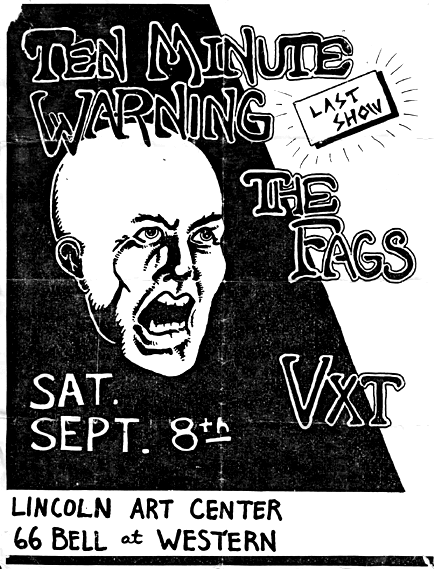
Top three photos of the Lincoln Arts Center taken by me in Summer 2023.
5. The October 1986 Dayglow Abortions Show: Cheating Death’s Last Stand
On Saturday October 4, 1986 I booked Canadian punk band The Dayglow Abortions to headline the Central Tavern. Cheating Death opened the show. Napalm Beach were also supposed to play but didn’t show up, because they had just lost another bass player. The Dayglows were supposed to be a four-piece, but one guitar player got stopped at the Canadian border and couldn’t get into the U.S., so they played as a trio for the 1st time instead. The lyrics were occasionally obscene enough for the owner Mike Downing to raise his eyebrows while he was tending bar.
Cheating Death’s performance that night was so good that even Mark Arm, who was then the lead singer for Green River, stood in the front row right in front of the stage and intently watched Slats play guitar, occasionally leaning his head back with a “Wow!” look of amazement on his face. They were a well-oiled machine that night.
Thanks to my efforts, Cheating Death’s set at this show was filmed by a professional videographer. Back in those days everyone didn’t have a cell phone with a built in video camera. Thanks to the lengthy legal proceedings, it wasn’t until 1984 the U.S. Supreme Court even approved the sale of VHS video cameras and videotape machines in the U.S., even though the equipment had existed in Japan for years. I had to find some guy who lived in Renton I think through an ad in the Rocket, hire him, and and pay him money to come down to the Central with his gear to film the show. Unfortunately, he didn’t bring any lights, and according to the bartender George for some reason someone had just removed all the Central’s stage lights, so the film turned out a bit dark.
He charged extra money for each copy of the VHS videotape, so we only had two copies made. One was given to Slats and the other to the drummer Gary “Wedg” Thompson. Nobody knows what happened to Slats’ copy. Blake Richardson did not find it in Slats’ room after his death in 2010. The only known surviving copy of this VHS videotape is still sitting in Wedge’s basement because he refuses to let anyone else see or hear it, even though it was my idea to have it made and I paid for it, so legally the copyright should belong to me.
Unfortunately, this October 4, 1986 show with the Dayglows was the last one for Cheating Death, because shortly thereafter Alex Sibbald got the call to join the Accused to replace their original bass player Chewey. Alex had played with Slats for nearly two years since Itchty Brother started up in early 1985 and was so good that he was considered irreplaceable. It’s hard to blame Alex, since he and Blaine Cook have continued to play together ever since in the Accused, the revived Fartz, Toe Tag, and now the Accused A.D., but his decision to leave broke up Cheating Death, a band that was really beginning to take off and still had lots of potential. The fact that the band’s singer Paul Barish was later arrested and went to jail for drug possession was the final nail in the band’s coffin.


Top left and bottom two photos of Cheating Death in 1986. Photographers unknown.
V. My Memories of Slats in the 1980s
One thing I’d like to dispel is the notion of the punk uniform. I think the mode of dress that became known as the standard punk uniform, consisting of the black leather motorcycle jacket, black straight leg jeans, and red converse high top tennis shoes, was kind of slow to develop. As late as the early ‘80s, the fashionable mode of dress among mainstream people was still the wide-leg, elephant flare, Brittania blue jeans you bought at the Squire Shoppe, with a big plastic comb that a had a huge long handle that you stuck in your back pocket for combing your long, blow-dried, feathered hair, and a button up polyester mock-silk shirt with a collar and orange and brown psychedelic patterns, maybe pooka shells or a gold chain around your neck, and a silk baseball jacket or letterman’s jacket.
So, even not having long hair and not wearing wide leg jeans would be enough to make you stand out as being different. It was enough to have frat jocks and heavy metal kids downtown and on Queen Anne Hill yell at me as I passed by on the street, “Hey faggot! When’s Devo coming to town?” Somehow the mainstream people could tell just by looking at you that you must be a punk rocker, without even talking to you or knowing what music you liked.
In the early photos of the Silly Killers, including the three of their shows that were photographed by Mike Leach, they aren’t’ dressed that strangely. In fact, drummer Tim Gowell never dressed punk, never wore a black leather motorcycle jacket, and never had a punk haircut, instead looking like a pretty normal nerd dressed in a cotton hoodie. Most of them did wear black leather motorcycle jackets and wore straight leg Levis 501 jeans, but they were blue jeans, not black ones. Except for Eddie having a nearly shaved head in the beginning, and Slats’ long sideburns, even their haircuts were not that abnormal. Clukey sported a pretty normal, mainstream haircut, probably because he had a day job working for a law firm and couldn’t afford to look too weird. Even in the 1982 photos taken by Emily Rieman for the Silly Killers single, Eddie was wearing a tuxedo jacket, not a black leather motorcycle jacket, and a white dress shirt with the collar turned up. The white dress shirt with the collar turned up was something that Andy Fortier had started, and later Carl Barish, Slats, and I all dressed that way too, sometimes cutting off the sleeves to make it sleeveless.
Straight leg black jeans were actually hard to find. One time in 1983 I went down to the Metropolis wearing a pair of Calvin Klein jeans, only because they were the only straight leg jeans I could find, and I knew I couldn’t wear my wide-leg Brittanias, even though I was embarrassed by the fashion designer name brand tag on the back, which I think I took off or tried to cover up.
Leather jackets were expensive, costing at least $100 or more, so sometimes we would substitute that with a sleeveless, denim vest, and write a band name on the back, or if we could afford a leather jacket we would protect it by wearing the denim vest over the top of it and avoid writing on it. Slats did have one on which he had painted the same Silly Killers crucifix logo that appeared on the insert in the 1982 Silly Killers single. At one point I was wearing a cheap black leather vest that I ended up selling to Alex Sibbald for $25.
As an example, in my own case, in 1983-1985 I was wearing a long, vintage, salt & pepper wool overcoat from the 1950s, that was kind of like the one Elvis Costello wore on the cover of his “Get Happy” album, until one night at the John Cale no-show show at Le Club Hit in 1985 I accidentally set it on fire by dropping a cigarette ash inside the right pocket. Keeto, one of the Bopo Boys, said, “Eric, you’re on fire!” So, I took it off, threw it on the floor, stomped all over it to suffocate the flames until they went out, and then put it back it on again, with a huge hole burned in the right pocket.
One of the cheapest options for avoiding the expense of buying a leather jacket but still dressing in all black, was to buy one of these vintage black cotton raincoats from a used clothing store like Dreamland. These weren’t like Gore-Tex rain parkas, they were these knee-length, black, cotton overcoats that had once been worn by white-collar office workers in the 1960s and 1970s but weren’t popular anymore so the used clothing stores had a lot of them. You could buy one for $25. They had a big collar you could stick up, and big pockets to stick all your stuff, like a pack of cigarettes, lighter, maybe a couple of cans of beer. So, a lot of us started wearing those same raincoats, which led to one hilarious incident. One night Eddie Huletz, Paul Solger, and I were at Eddie’s house getting ready to go out to a show, probably at the Gorilla Gardens, and I put on the black raincoat that I thought was mine, except that Eddie and Paul wear also wearing the exact same kind of jacket. I reached into the right pocket and felt something big and bulky was in there. Perplexed, I said to myself, “what’s that?” I grabbed whatever it was with my hand, pulled it out of the pocket, and discovered it was a fully loaded rig, a syringe full of dope. Right away Eddie said, “Eric, you put on my jacket! I was all ready to go out!!” He thought it was funny. Paul kind of silently grinned. It was one of the first times I realized that all my friends were doing dope, smack, aka heroin. They’d probably been doing it since 1983, but had kept it sort of hidden, and/or I’d been too naïve to figure it out until then.
As Slats’ fashion sense evolved he eventually did develop sort of his own look, but that took until about 1985. He liked wearing these shoes known as “creepers,” that had really thick, black soles on the bottom, sort of pointed toes, and leather uppers, sometimes leopard skin material on top. For a shirt he would usually wear a band T-shirt for the Ramones or maybe the U.K. Subs, often with the sleeves cut off to make it a tank top. He liked sleeveless tank top shirts for some reason. Sometimes he would revert to the Andy Fortier/Carl Barish thing of wearing the white dress shirt with the collar turned up. At some point he seemed to lose that leather jacket with the Silly Killers log on the back and started wearing a cheaper one that actually had silver duct tape around one sleeve covering some rips in it, until later in the 2000s he seemed to be able to afford the acquisition of a much more expensive collection of leather jackets in different colors. Straight leg black jeans became more common as they became easier to buy, but for some reason for a long time he wore this pair of jeans with a two-tone color scheme, black in front, blue in the back. Black and blue was appropriate I guess. And of course a black leather belt covered with silver metal studs. The big black bolero hat with the wide brim appeared sometime around 1986. I’m not sure what inspired that. It’s tempting to say he got it from Izzy Stradlin, but I think he was doing it even before GNR became famous in 1987, and it became one of his trademarks.
1986 proved to be a busy year for me personally as a band manager, I had gone from managing Debutante at the start of the year, to managing Slat’s band Cheating Death in the middle of the year, to managing Tom Hansen’s band the Crotch Rockets at the end of the year. Over the next few years I would continue to book shows by bands such as the Crotch Rockets, Canadian punk band D.O.A., the all-girl band Frightwig from San Francsico, Kim Warnick and Ronny Bopo’s band Sway, the False Prophets, Big Jim Norris’ Crisis Party, and Enigma Records recording artists S.G.M. through 1989. Unfortunately for Slats, the breakup of Cheating Death in October 1986 proved to be the end of his roughly seven-year-long career as a musician that had started in 1980, at least until a revival in the 21sts century during the last decade of his life.
After Cheating Death broke up at the end of 1986, Slats and I continued to hang out together for the rest of the 1980s. From 1986 until I moved away in 1991 I would say that he was probably my best friend. Sometimes Slats and I would go out together to dive bars on Capitol Hill where invariably Scott Dittman of the Zipdads and Carl Barish of the Boot Boys and Brad Ramels of the Lewd would show up to have a drink with us.
I made several attempts to set up a new band for Slats, including recruiting a singer we saw stand in with Life in General when Kelly didn’t show up, and an attempt in late 1988 to introduce him to the guys of SGM as replacement for Rich (aka Bitchard Louis) but it never worked out, and he never played music again for the rest of the decade.
Besides the stuff we actually did together, Slats also confided in me a lot of personal stories about his life. His first rock concert was when he went to see Alice Cooper play a show in Seattle sometime in the '70s, probably the 1975 "Welcome to my Nightmare" tour. Slats was still too young for his mom to let him go alone, so she only agreed to let him go to the show when an old grandma in their Montlake neighborhood agreed to go with him as a chaperone. It was the tour where Cooper chopped his own head off with a guillotine. Slats said the show changed his life forever, and the grandma apparently enjoyed it, too. If it were the June 21, 1975 show,, Slats would only have been three months over 12 years old, which seems a bit young, but would explain the need for a chaperone. Cooper didn’t come back to Seattle again for another four years until April 3, 1979, when Slats would have been 16, but this seems a bit late for our chronology.
His parents got divorced, his dad left town moved away to Canada, and his mom Mary Ann started living with a boyfriend at his house, so Slats was basically allowed to live rent-free in his mom's house in Montlake until the end of his life in 2010. He always claimed to be somehow related to the celebrity Edie Sedgwick (1943-1971) who had been one of Andy Warhol’s superstars, and in fact Sedgwick was his mom Mary Ann’s maiden surname, and it was legally Slats’ middle name, too.
His favorite drink was a whiskey sour. His favorite band was the Ramones, but close runner ups were D.O.A., Social Distortion, and the Dickies.
Although he was most known for the Silly Killers, he was in a string of bands, starting with the Zipdads, which also included Duff McKagan and Andy Fortier; then the Silly Killers, which also included Duff McKagan on drums in a later incarnation than appears on the 1982 single; followed by Itchy Brother in 1985; and then Cheating Death in 1986-87. I'm sure he was in other bands later, but those four in a row from roughly 1981 to 1987 were the high point of his career as a musician. With those groups he opened for many famous touring acts including Black Flage and Social Distortion once each; Husker Du three times; D.O.A. twice, the Dayglow Abortions twice, etc. Silly Killers were even booked to play the Fastbacks 1982 E.P. record release party, but got booted off the bill for being too controversial. The Silly Killers went through several lineups between 1982 and their final break up in the spring of 1984.
Although I knew he was long before that, having been the music critic for the Western Front newspaper starting in January 1983, the first time I recall actually meeting Slats was in the Summer of 1984 when I was so drunk that I had passed out in the front yard of his mom's house in Montlake during a party there. He dragged me into the back yard by both arms, so that the cops wouldn't see me in the front yard. From my prone position on the ground I managed to reach into a jacket pocket, pull out a Penetration Presents business card, extend it upwards into the air, and say "Here's my card, call me." I ended up sleeping on the couch in the living room overnight and didn't go home to my dad's house on Queen Anne Hill until the next morning. After I woke up I realized that he had put white Maalox all over my face while I was unconscious. From there I walked back across the Montlake Bridge over the Ship Canal at dawn, and caught a #43 bus from the U-District back home to the foot of Queen Anne Hill, where my dad immediately put me to work doing household chores after having had almost no sleep and being extremely hung over.
Slats and Carl Barish worked security at the back door of my Spider's Web show in 1984, meaning they sat there drinking beer while letting everyone get in for free.
After On The Rocks broke up in May 1985, Slats and I drifted closer together as the other guys in On The Rocks gradually drifted away from me and out of my life.
In mid-1985 I tried to organize a Silly Killers reunion show. Anthony Rhodes, aka Tony Godbehere of DSML and the Holy War Cadets, agreed to promote it at the Gorilla Gardens, but it was my job to rope all the guys together. I distinctly recall the individual conversations I had with each one of them. I had to talk to each one separately and negotiate a deal, just like when I was managing On The Rocks I would patch up the differences between the members and their egos. Of course, the big obstacle was the relationship between Slats and Eddie. Slats was the most eager to do it, and Clukey was into it, but Eddie was the most difficult. He said he would only do it if he was guaranteed to be paid a certain minimum individual fee just for himself, not a guaranteed fee for the band as a whole, because he had already forgotten the lyrics and would need to relearn them again. It wasn't long before Slats fired Eddie again and decided to revert to Gary Clukey on vocals and Todd Fleischman on bass. I forget who was going to play drums, but it certainly wasn't going to be Duff, who by that point had already moved to L.A. in the summer of '84. At that point Anthony Rhodes pulled the plug on the show, arguing that "It's not the Silly Killers without Eddie," which is hard to argue against actually.
In the latter half of 1985 I managed a Seattle bar band called Club 19, using my connections from my days as the Western Front music critic in 1983-1984 with people like Steve Pearson of the Heats to get them gigs as an opening act at clubs like the Hall of Fame and Astor Park. Club 19 had a guitar player who had moved to Seattle from Sweden as a foreign exchange student at the UW. His name was Hakan Svensson. I used to tell Slats about them, until one day he started calling me “Hogan Svenson” as a pet nickname. He had a lot of pet nick names for people, which weren’t always flattering, like “Crazy Jeff” for Jeff Murphy because he had this scam where he was trying to get free money from the state by always pretending to be crazy while in public places, such as on the bus, where he suddenly stand up and say, “I love all of you!” Later he became a Christian missionary. Anyway, the only person who to this day still knows me as “Hogan Svenson” is Alex Sibbald.
Although in the last decade of his life in the 21st Century he became more associated with Broadway on Capitol Hill, in the 1980s his main hang out was “the Ave,” aka University Way in the U-District. We often hung out at a place on the Ave known as “the bank,” which was a vacant commercial space where a bank had once been. It had a sort of covered outdoor alcove in front of it, with it a kind of bench built in between two pillars. We would just sit there, along with members of the Bopo Boys such as Jon Driver and Ronny Bopo, and watch the foot traffic walk by.
Alex Sibbald could often be seen sitting on his parked motorcycle, while there was this other odd old guy who would ride back and forth, up and down The Ave on this vintage 1950s motorcycle, looking like one of the cast of Marlon Brando’s “The Wild One,” only like 70 years old. That guy never stopped to talked to us, and we never knew who he was, although we always wondered if he was some retired UW professor or what. Alex was the only one who ever said he went over to the guys house once and found a collection of vintage, weather-beaten, old leather jackets hanging all over the walls, but he was too afraid to ever go back there again.
Sometimes we would go up to the Hall of Fame, which by night was where bar bands such as the Heats, Rangehoods, Allies, and Cowboys would play. He hated the types of bands that played there at night, but in the daytime he liked to use their pool table to shoot pool while having some drinks. Other times we would walk up the street to the Lox Stock and Bagel and have some stiff drinks there. He would often need a drink before heading off for his curb painting job. He wasn’t much of a coffee drinker, so whenever I was with him we would not hang out at the coffee shops on The Ave such as the Coffee Corral, Café Roma, or IHOP, since none of them served alcohol, and he usually needed a stiff drink.
Although D.O.A. were one of his top three favorite bands, Slats never seemed to be very political, certainly his own songs never were. He had a more nihilistic outlook on life, which was expressed by his favorite phrase, “Let’s go nowhere, real fast!” His other favorite phrase, “Let’s spice it up,” epitomized his party lifestyle.
In 1986 I managed Slats’ best post-Silly Killer's band, Cheating Death, which featured Carl's brother Paul Barish on vocals, Gary Thompson aka "Wedge" on drums, and Alex Sibbald on bass. After doing shows at the Lincoln Arts Center, the Ditto, and the Central, where they actually filmed a VHS videotape of an entire set one night, the band broke up when Alex left to join the Accused in 1987.
It was during this time that Slats, Paul Barish, his girlfriend Mary, Brad Ramels of the Lewd, and I, hung out a lot together at Mary's house on Brooklyn Ave in the U-District a lot. Kevin Eastwood, aka Kevin Collins would also be there because he used her mailing address to get his social security checks. I guess you could say it was a sort of “shooting gallery.” Everybody else there was doing heroin, except for me. Mary had inherited a large sum of money from a grandmother or somebody and ended up spending it all on drugs. She was a very generous host, always asking me any visitors, including me, if the wanted any, and busily cooking it all up in the kitchen, until eventually the money ran out.
I would ride in the back seat of Paul Barish’s car when Paul and Slats went on drug runs to score some more stuff. We would park in some back alley while one of the two would go inside a back door, probably into some dive bar, to score. Before going in, Slats would always ask Paul “C or D?” This was a code phrase for “Coke or Dope?” Nobody ever actually said the word “heroin” back then. Some other nick name was always used, like smack, dope, etc. I guess they thought they were hiding from me what was really going on, but I wasn’t that stupid. Still, the drugs never seemed to affect Slats that much. Unlike other junkies, I never saw him so totally incapacitated by it that he couldn’t play a show or function normally. And during the whole time I knew him, he was never a dealer selling the stuff, just a user.
Although he never really had what you'd call "a real job," he wasn't lazy either. He rather creatively thought up this idea for a curb painting business in which he would walk around affluent residential neighborhoods with a can of white paint and a brush, and some stencils, knock on people's front doors, and offer to paint their house address numbers on the curb in front of their house for $10.00 each, with the selling point being that if the police, fire dept. or ambulance had to come to your home in a hurry for some emergency, seeing the address painted on the curb would assist them in finding your house faster. The idea seemed to work, but he always needed to have a stiff drink at a bar on the Ave before heading out to knock on doors and find some more customers.
His other M.O. was to date strippers who always came home with loads of cash from tips. They would rent an apartment and live together and there would always be cash flow coming in from stripper tips every day. That plan also seemed to often work, so the guy had no shortage of clever ideas.
For a while he and Carl Barish had a schtick called “the Robe Warriors,” where they would go out wandering around the U-District at night dressed in bathrobes, and ask passersby to pay them $10.00 to watch them punch each other.
Whenever Slats and I went out together for drinks, dinner, or lunch, usually at a bar or restaurant on the Ave in the U-District, he always paid his share with his own money and he never mooched off of me, not even once. Often he would run into me in the street and say, “maybe I should I eat something,” so we would go to a restaurant and have meal together, but he would always pay his share. If he hung out with me he would do something heathy like eat, the worst thing we would do together would be to get drunk on some stiff drinks, a screwdriver for me and a whisky sour for him, whereas if he hung out with other people he would be more likely to do drugs, and he seemed to appreciate that. We always had great conversations where we could talk freely about anything, music, girls, you name it. We always shared a great mutual understanding of the other. The few times we had a quarrel I would revert to calling him by his real name, Chris Harvey. He didn’t like that. He always wanted to be known as Slats.
I made it a strict rule from the beginning that our relationship was never going to involve me supporting him or his drug habit financially. One day he came to me on the Ave and said he was desperate for $50 bucks because he had to pay back a debt he owed he owed to a guy on Broadway that same day. He also got me when he sheepishly said, “I’d do it for you.” But, I could tell it was for a drug deal, so I said no. It was tough love. Another time on the Ave he tried to sell me a pair of black leather pants, which I assumed were stolen, for $100, but I just told him no, I wasn’t interested. If it were a viable band project then that would be a different story that might cause me to invest in it. We once talked about him making another record.
Slats, Mary, Paul Barish, Brad Ramels and I would often all go down to shows at the Paramount Theater in a big group, dressed in black leather motorcycle jackets, and just walk in for free without paying. The doorman would be too afraid to say anything or even try to stop us. Or else he thought we were with one of the bands playing that night. We did that at least twice that I recall, once for John Lydon’s Public Image Ltd (PIL) and once for Debbie Harry of Blondie. I recall that at the PIL show Lydon’s band actually played two Sex Pistols songs, something that he had said he would never do. One was obviously “Anarchy in the U.K.,” but I forget what the second one was. After the Debbie Harry show, Slats and I went back to her tour bus, where he got her to sign her autograph on his T-shirt, which he took straight off his back and gave to her to sign. I’m pretty sure it was Chris Stein doing crowd control at the door of the tour bus.
We once went to the Seattle Center Fun Forest and bought matching black bandana's with white skull and crossbones on them. They were obviously meant to have some sort of Pirates of the Caribbean theme to them, but I thought they looked kind of punk rock too. It was my idea that we should buy them. I saw them for sale first and pointed them out to him. He agreed they were cool so we each bought one. We wore them tied over our heads. I soon lost mine, but he kept wearing his black pirate bandana tied over his head for years, using it to hold back his increasingly long hair. Probably most people didn't know that we had bought those bandanas together. He had a unique way of tying the bandana around his head, then wearing a hat with a large brim over that, and balancing a pair of sunglasses over the front of the hat. I guess all this was meant to cover up his curly red hair.
We saw the last Life in General show together at the Seattle Center during Bumbershoot 1987, the one where the singer Kelly failed to show up and the band played without him. They had just attempted to do a West Coast tour down to L.A., motivated by the local success of their song “Vaporized,” but discovered that nobody outside of Seattle knew who they were, so Kelly had quit in disgust as soon as they got back. Some kid from the audience jumped up on stage and sang with them instead. Afterwards we ran into the kid and I told Slats he should nab him to be the new singer for his next band. He wanted to say hi to the guy but he was too shy.
In 1987 I did succeed in introducing to him a nice girl named Christina King, who worked at the Urban Renewal record store on the Ave and became his girlfriend for a while. On June 27, 1987 we all went to the X show at the Moore Theater, with Sabrina Bentley as my date. I had won four free tickets by winning a contest on KCMU, something which I also did with the 1985 Ramones and 1987 Replacements concerts, so we all four got to sit in box seats in a balcony overhanging the stage from one side wall, providing us with a birds eye view of the show. Sabrina had just broken up with Mike O’Malley and now was a big chance to seize the opportunity, but at an after show house party in the U-District I got so drunk and obnoxious that Sabrina walked out on me and went home alone early. I never got a second chance, and I’ve been trying ever since. Later, Slats and Christina’s romance ended in a bizarre five-sided love pentagon involving both of them, me, a red-haired girl I worked with who was a student at the UW, and a guy who worked at the Time Travelers record store downtown.
Until April 2024, I never knew what had ever happened to Gary Clukey after he went MIA in 1990. He was a lot older than the other members of the Silly Killers and state somewhere in the midwest, where according to Slats he would “keep a bottle in his desk,” but would often come back to Seattle for visits until around 1990 he stopped coming back. On one return visit in 1987 he hung out with me and Slats a lot, and there was much talk of the Silly Killers. Gary had a cassette tape of a live recording of a Silly Killers show, and we would often play that on the car stereo while driving around town. Unfortunately, it was a recording of the Silly Killers II lineup with Clukey singing. On the tape, Clukey would say hilarious things, such as, “Now it’s time to introduce the band. I’m Gary. Everyone else can fuck off!” Ha, ha, ha. It also turned out that Clukey had a large stash of mint condition Silly Killers vinyl singles stored away in his basement, which nobody had known about, at a time when Slats himself didn’t have a copy anymore. I can remember going to a house party with Gary where they were playing Alice Cooper's song "I'm Eighteen." He sang along but changed the lyrics to "I'm thirty, and I don't know what I want!" At the time 30 years old seemed really really old to me, and it made me realize how much older he was than the rest of us, since Slats and I were the same age, both having been born in 1963.
In his pre-Sub Pop fame and fortune days, from 1987 to 1988 Jonathan Poneman briefly ran a lame over 21 club at 3244 Eastlake Ave East called "Scoundrels' Lair," which had a corner tower with a peaked, conical top, and had once been called Rapunzel’s. Slats and I never went there because the music was mostly too New Wave for our hardcore punk tastes. But on the last night it was open Slats and I decided to go down there just for a laugh, since it would be our last chance to see what it was like. We walked up the stairs to the second floor space and encountered Jonathan Poneman, who was working the door himself. He sees us and immediately says, "Oh no! Not you guys!" We just barged in without paying the cover charge and he didn't try to stop us. We stood there and watched a faux goth band called Bark in the Dark play the final set at that club. We were not impressed. We stood right in front of the stage watching the band, trying to figure just what it was they were trying to do, looked at each other with perplexed expressions, and said “WTF is this?”
When I was managing S.G.M. in 1988-1989, I tried to get Slats to join that band as their second guitar player to replace Rich (Bitchard Louis). On November 11, 1988 we all went to an all-ages show at Union Station, a former train station, where Sonic Youth were headlining that night, and were standing outside when I introduced him to all the members of SGM (minus Rich) and said, "Here's your new guitar player." They looked afraid of him, while he was sort of defensive and shied away from talking to them too, so it was clear the chemistry wasn't there and nothing came of it. That was also the same night that some other guy who was apparently an old friend of his said, "Slats, don't these kids know that we started all this?" It was clear that a changing of the guard and a new era were in the air.
In 1989 when Mother Love Bone’s “Shine” E.P. came out, I went over to Slats’ mom’s house in Montlake to find that he’d just been listening to it and still had it on the turntable in the living room. I was kind of shocked and felt even more surprised when he said, “It’s not that bad.” For a guy raised on hardcore punk rock, he was broadening his musical tastes faster than I was at the time.
On June 16, 1990 Slats and I went to see Social Distortion play at the Lake City Concert Hall, a new music venue which until very recently had been a movie theater. This was the first time Social Distortion had played Seattle in the eight years since Slat’s band the Silly Killers opened for them in 1982. After their debut album “Mommy’s Little Moster” had come out in 1983, there had not been any national U.S. tour in support of it because Mike Ness was too strung out on drugs, and at the end of the year the rhythm section of Derek O’Brien on drums and Brent Liles on bass had quit the band, leaving only Mike Ness and Dennis Danell from that lineup. Although a new lineup was quickly formed in early 1984 with Chris Reece of the Lewd joining on drums, and John Mauer on bass, the band’s sound changed dramatically to more of a Country Western sound, then Ness went off and joined the band Easter in 1985, and Social Distortion were largely inactive until in 1988 they got a distribution and marketing deal from Enigma Records for the “Prison Bound” album, the recording of which had actually been financed by their longtime friend Eddie Egan, and that 2nd LP then led to a major label record deal with Epic in 1990.
Almost the whole set at this June 1990 Seattle show was new songs off their self-titled major label debut LP on Epic records, which at times had an almost acoustic, sort of Country and Western, folk rock sound, and they played nothing at all from prior to the 1988 “Prison Bound” LP. As sort of a sop to the audience, Ness came out wearing the same sad face make up he had on the 1982 tour, and he and Danell jumped up in the air in unison once while playing a song. After having waited eight years to see them, both Slats and I felt pretty disappointed by their lackluster performance. Slats commented that “They didn’t used to be so restrained.”
Since my friend Mike O’Malley, who was living with Sabrina Bentley when I first met them, was hanging out with Mike Ness at the time, I got invited to go backstage and met the band in the back parking lot behind the venue. By that time I had been able to afford to buy a new black leather motorcycle jacket and had my hair kind of slicked back with gel in imitation of Ness’ look, and some other fans actually confused me and O’Malley as being members of the band, to which Ness politely responded that “These are just a couple friends of mine.” So in one brief exchange I was both mistaken for being a member of Social Distortion and described as a friend of Mike Ness. Ness commented that he was upset that on this tour their old fans didn’t like the new material they were playing, but the new album hadn’t yet acquired any new fans either. He said, “I feel like cryin’ or takin’ a life.” At first he was nice to me, but unfortunately for some reason I mentioned Mike Palm of Agent Orange, a sort of Orange County punk rock rival of his who had at the time stolen away the “Mommy’s Little Monster” rhythm section of Derek O’Brien and Brent Liles. This mention of Mike Palm triggered an immediate explosion of anger from Ness, who screamed “Nooooo!” and almost punched me in the face. Getting clean and sober had not changed his bad temper at all. In that sense the guy was Punk as Fuck, even if his music sucked by then.
In 1990 Joe Shithead of D.O.A. made the first of many decisions to break up the band and came to Seattle for a show at the O.K. Hotel on November 25, 1990 for what was supposed to be their last show in the city ever. They had this song called “Lumberjack City,” where Joe would pull out a real chainsaw, fire it up, and wave it all around. Slats went to this show and witnessed how during this song the chainsaw shtick went sideways and Joe cut off part of one finger, causing blood to shoot all over the stage. Nonetheless, Joe kept playing until they finished the show and didn’t get his finger treated until they had driven all the way back up to Vancouver, B.C. Slats was fascinated by this bloody incident and wouldn’t stop talking about how “there was blood everywhere.” Echoes of his firs concert experience seeing Alice Cooper chop his own head off in 1975.
When his dad died in December 1990, he took a flight to the funeral, which as I recall was in Toronto, Canada. He knew he couldn't take any drugs with him on the plane, and after he arrived he didn't know anybody there who could help him score, so he told a cab driver, "Take me to the worst part of town," and that idea worked. This was a similar situation as to when I took Tom Hansen’s band the Crotch Rockets up to Vancouver, B.C., Canada on November 26-27, 1986 for two shows with D.O.A. but because they couldn’t score any drugs we had to abruptly drive all the way home to Seattle immediately after the second night’s show. Contrary to the vicious online rumors, Slats was not walking with a cane at this time in December 1990. I know that because I was there in Seattle spending time together with him then.
Slats, Jeff House, and I spent my last New Year's Eve in Seattle together on December 31, 1990. It was a wild ride all across town full of many hijinks. On that infamous 1990/91 New Year's Eve he had somehow acquired a credit card, which I think actually belonged to Jeff House's girlfriend, and he used that to pay for all of our drinks at some pretty ritzy bar down on the waterfront, Pier 70 I think, before we headed across town to a house party. The weather was so cold that they had actually dropped the credit card on the ground after which it broke in half into two pieces. Fortunately, Jeff House’s sister worked at Pier 70 on the waterfront, this pick up bar where cover bands often played. We could still go there and she would serve us drinks, letting us use the broken card to pay for them, but other places wouldn’t take it, leaving us a bit short on actual cash.
After we had stiffened up at the bar, it was time to head out to the house party. It being New Year’s Eve, it was not easy for us to catch a cab. After we had finally hailed one and all three piled in, Jeff House started poking some fun at the cab driver, saying stuff like, “Hey, you’re pretty cute.” The cab driver, who seemed to be a Muslim immigrant from Pakistan, was not amused and threatened to throw us all out on the street. With the time getting late and midnight fast approaching we didn’t have time to waste to get to the party. So I had to intervene to calm down the driver and tell him that Jeff was only joking and we had plenty of money. Actually, I was the only one who had any cash on me, the others having relied on the broken credit card to pay their bills all night, so I was the one who ended up paying for the ride.
Once we managed to get to the house party it was just like old times. The house was full of punk rock girls, none of whom had brought a date. Before I knew we had all three hooked up with somebody. Those were the days when three guys who didn’t have any money, or really anything to offer a woman in a purely logical sense, could still easily score a one night stand just by acting and looking cool. It was amazing to see Slats go to work on this one girl, persuading her to start kissing him right in the kitchen. It wasn’t long before Slats and Jeff both took off with some chick and went home with her.
I was left alone at the house party with this one chick who had big boobs but a big scar on her face. I had actually met her earlier at a pretty sparsely attended SubPop annual Christmas party at some dive bar downtown, where Bruce Pavitt had played the role of DJ and played the Wipers debut 1978 “Better Off Dead” single, which was still pretty rare at the time. Mike O’Malley had been there too, as well as Jim Tillman of the U-Men, but Tad was really the only SubPop star present. Nobody from Mudhoney or Nirvana were there. SubPop still wasn’t a big deal yet, and Jonathan Poneman had actually left alone early. The chick I was with was hot enough that he actually pinched her ass on his way out of the bar, or maybe he just did that to try to embarrass me. Anyway, this chick had been chasing me ever since then, but because she had a scar on her face, and I did too, I was worried people would joke about us being the scarface couple. So that night I hesitated until finally she went home with some other guy, walking out of the house whle giving me an evil eye dirty look, and I ended up going home to my faithful girlfriend Vicki Dietzel after all.
On New Years’s Day 1991, Slats and I stood on Broadway and said our last goodbye. I was moving back East to Washington, D.C. to resume graduate school and get my Master’s degree. He knew I was leaving and that this might me the last time we would see each other. Stading there side by side dressed in our black leather motorcycle jackets, Slats said to me, “I’m sure gonna miss you.” Coming from such a badass tough guy, I couldn’t believe he would say that to me, and be so expressive of his emotions. Right then some young teenage kid walked past us and said, “A couple of faggots.” It kinda ruined the moment. I felt so angry at the kid that I shouted, “We’re not faggots, we’re punk rockers! Don’t you know the difference?” But Slats just shrugged it off. Here it was 1990 and punk rockers in Seattle were still being called “faggots,” just like we had been when I first got into punk rock way back in 1981. The so-called “year punk broke” hadn’t happened yet, and being punk still wasn’t popular yet, and wouldn’t be until after Nirvana exploded at the end of 1991.
VI. The 1990s: Slats’ Lost Decade
Not much is known about what Slats was doing during the 1990s decade. After I moved away I went only went back once, in the Summer of 1991, and for some reason I didn’t see him then, even though I went to a couple of shows where he should have been there. After a kind of unpleasant experience visiting the bigger and newer RCKNDY club to see Pearl Jam and Temple of the Dog, I felt out of place there and wander over to the much smaller and older Ditto Tavern on 5th Avenue, where I found Paul Barish’s new band the Suffocated were playing. Paul had switched from vocals to guitar playing, while the rest of the band featured two former members of the Boot Boys on drums (Rick) and vocals. Paul’s brother Carl Barish was in the audience, so I hung out with him, but Slats wasn’t there. I also went to a show by the Dickies at the Off Ramp on Eastlake Ave, and Slats wasn’t there either, even though the Dickies had long been one of his favorite bands, and everyone else from the old scene was there, including Paul Solger, Dain Hudson, Christina King, and all of the Rejectors (who were piled up in the doorway and apparently comatose on acid or some mind altering substance.)
In 1992 Slats’ childhood friend Tom Price had his band Gas Huffer record a cover version of the Silly Killers’ song “Knife Manual” off of their 1982 single. This cover version of “Knife Manual” was released as part of a split single between Gas Huffer and Mudhoney. Unfortunately, Slats’ seems to have been unable to capitalize on this publicity by using it jump start his musical career at the time.
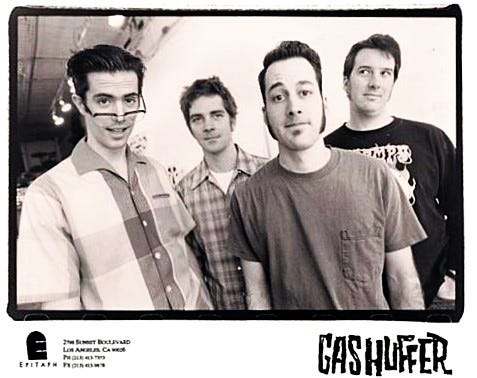
He was reportedly caught in some big drug bust in the late 1990s where he almost had to go to jail and pay a large fine, so maybe during this time he tried to follow Tom Hansen’s example of converting from being a musician who did drugs to becoming a full-time drug dealer who no longer played music. I don’t know. I wasn’t there during that time and pre-Internet I was out of touch with people.
VII. Pain Cocktail
After he moved to Seattle in 1998, Blake Richardson became Slats’ new best friend for the last decade of his life and brought him out of musical retirement by starting a new band with him called Pain Cocktail. Based the few surviving flyers, Pain Cocktail actually played shows at some high profile venues including the Central Saloon, the Funhole, and the Comet Tavern.
Blake Richardson was the singer for Pain Cocktail, which also included bass player Lauren Goffin. After Slat’s death caused Pain Cocktail to break up in March 2010, Blake and Lauren Goffin continued to play together in a new band called Die Nasty, which later evolved into the now pretty successful band 38 Coffin, who have even been interviewed and played on FM 100 KISW, “Seattle’s Best Rock!”
During this time Slats had stopped playing his trademark Gibson SG he used in the 1980s and switched to playing a Gibson Les Paul. His appearance also changed somewhat, with long, bushy, red hair sticking out from under his big black bolero hat. He wore a variety of leather jackets, sometimes not merely black ones, but also in different colors such as silver and white.
Pain Cocktail never officially recorded or released any studio recordings. They were reportedly scheduled to go into the recording studio at the time of Slats’ death. However, they were filmed during some rehearsals in the Summer of 2008 at Crybaby Studios, including the eight songs “Bitch,” “Death of Me,” “Brakes on You,” “Hard Times,” “Miracles,” “Too Much,” “LUV,” and “Blake Don't Know.” The footage was later uploaded by Lauren Goffin to her YouTube channel on March 11, 2011 in three installments totaling over 22 minutes.
Pain Cocktail Lost Footage 1:
Pain Cocktail Lost Footage 2:
Pain Cocktail Lost Footage 3:
On June 24, 2008 it was reported by Hannah Levin in an article in the Seattle Weekly newspaper called “Return to Squid Row” that Slats had appeared in a movie called “Calamari Union” directed by Richard Lefebvre of the Ranch Recording Studio, along with other local music scene celebrities such as Mark Arm, Otis P. Otis, and Ben Shepherd. It was a localized remake of an earlier 1985 Finnish film of the same name by Aki Kaurismäki. A two-minute trailer was reportedly completed and had a limited showing, but it’s not clear if the full film was ever released or not. On July 22, 2008 a 2:25 clip from the film was uploaded to YouTube. Slats appears at the 1:38 mark, sitting on a wooden boat dock on Lake Union, all dressed up in his black leather jacket and big black hat, smoking a cigarette. https://www.seattleweekly.com/music/return-to-squid-row/
Contrary to a lot of vicious rumors online, Slats did not die from either a drug overdose, nor from AIDS. He had gotten clean by 2005, although he never got sober and had continued drinking and smoking til the end. He could be often seen having a drink at bars on Capitol Hill such as Ernie Steel’s or the Cha Cha where Kim Warnick worked as a bartender. He died from an infection triggered by an accident in which he broke a hip bone when he fell down while running to catch a cab. Having been out partying with him many nights in the 1980s, I can totally picture this type of situation where he is frantically running to catch a cab, in order to get to the next party or go home afterward.
It seems that what should not have been a fatal injury became infected because he didn’t stay in the hospital as long has he should have, always leaving early either due to the expense of the medical costs or because he couldn’t stand being cooped up in there where he was unable to drink or smoke (or do drugs, if he still were). While in the hospital, he was reportedly calling old friends such a Dahny Reed of “The Fags” band on the phone and desperately telling them, “You gotta come get me out of here!”
Slats never got married, and never had any kids that anyone knows of. He was a swingin’ ladies man til the end. Although he definitely wasn’t Gay, he had many LGBTQ friends, particularly people from the early Seattle punk scene that they’d been an important part of.
After Slats' death on March 13, 2010, one day before his birthday, Blake Richardson hosted a large memorial show for him at Merchants Cafe in Pioneer Square. Dahny Reed of “The Fags,” a band starring Upchuck and Paul Solger that had been active from 1980 to 1984 and then periodically reunited once each year through 1988, got up and played guitar. There is a photo of Blake Richardson and Lauren Goffin playing a set with a banner behind them reading “RIP Slats.” A number of people signed their names on a poster of him.
Paul Barish, the former singer of Slats’ band Cheating Death, recalls that the next day there was a second memorial show dedicated to Slats held at the Funhouse on Eastlake Ave E., the former Off Ramp Café where I saw the Dickies play in the Summer of 1991. However, he may be confusing this with a “benefit” held on Saturday July 30, 2011 at the Funhouse where he got up and played an acoustic set. This show was apparently an attempt to help Slat’s mom pay off all the medical debts Slats had incurred while in the hospital. At any rate, it’s a testament to how much Slats was loved that he got not one but multiple memorial & benefit shows dedicated to him.
After Slats’ death in March 2010, Blake Richardson actually moved into Slats' house in Montlake after his death & took care of his mom as her caregiver during the final three years of her life until the day she died on December 14, 2013. He inherited a lot of Slats' personal belongings, including his wallet, his Washington state ID card, his black leather jacket with white belt & piping, his black bolero hat, his belt buckle, his collection of band T-shirts, & an archival photo of the Zipdads from 1980.
Once Marry Ann herself passed away in December 2013, Slats and his mom were buried side-by-side in a joint tomb. The inscription on the joint tomb reads “Loving Mother and Son.”
Other memorials to him around town include a bottle cap portrait that was on an outdoor wall but now graces the ceiling of the Comet Tavern, and a name plaque at the Pike Place Market.
Much like Gary Clukey, I was not only out of town but actually out of the U.S. at the time of Slats’ death in 2010. Wrapped up in the midst of the height of my own real career, and living overseas in Asia, I didn’t learn about Slats’ death until three years later in 2013 while I was casually surfing the web trying to catch up on what I’d been missing back in my hometown. The news hit me so hard that it actually caused me to stop drinking alcohol. I poured out my last bottle of whiskey on the ground in honor of him, and I haven’t had a drop of the hard stuff since then. Although I never did drugs, Slats’ death made me realize that I had been a serious alcoholic all along.
A couple years ago I almost backslid and posted on FB that I was going to get drunk on New Year’s Eve, but Tom Hansen (1961 – 2023) intervened to advise me not to, so he saved the day. Now he’s gone too. The number of people who were actually there in the 1980s Seattle music scene keeps dwindling by the day. It’s up to us remaining survivors to tell the tale before it’s too late.


Most photos in above gallery provided by Blake Richardson.
Post Script
This long essay is meant to be a free sample of an excerpt from a future full-scale book on the 1980s Seattle music scene that I’ve been working on since 2013, but has been repeatedly delayed by death threats, personal attacks, and warnings not to do it every time It’s been mentioned online. In most cases the identity of the photographer who took the pictures or the designer who made the poster is not known, but is identified in the few cases where it is known. Likely candidates for photography credits include Emily Rieman, Lance Mercer, Carlene Heitman, and Blake Richardson. None of Mike Leach’s photos have been used, at least not knowingly, and instead I’ve provided links to where you can find them online. On the Internet such images are pretty much free use, whereas in a printed book for sale that could get me in trouble. Nonetheless, I’ll update photo credits later if more information becomes available.
Eric N. Danielson
(01-01-25)